Manchester City face a new era after Pep Guardiola exit, as Khaldoon Al Mubarak reflects on his legacy and the club next move.
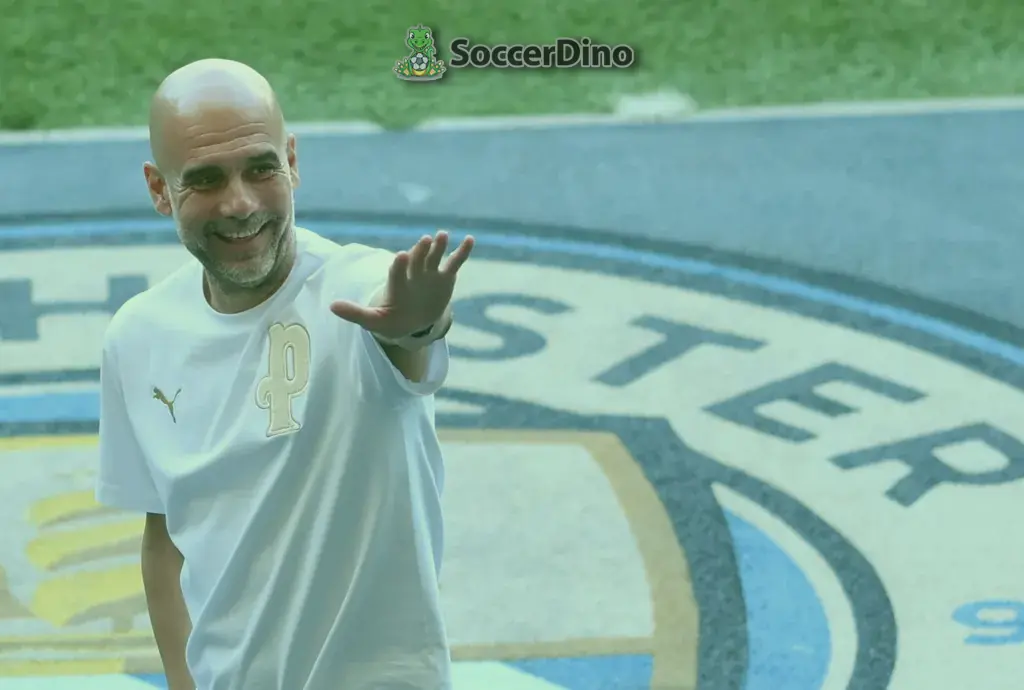
Khaldoon Al Mubarak reflects on Guardiola departure after historic Manchester City era
Khaldoon Al Mubarak, chairman of Manchester City, has spoken with unusual openness about the departure of Pep Guardiola from the English club, marking the end of one of the most successful managerial eras in modern football. After a decade in charge at the Etihad Stadium, Guardiola leaves behind a legacy built not only on trophies, but also on identity, dominance, tactical innovation and a complete transformation of Manchester City’s place in the European game.
The Spanish coach’s time at City will be remembered as a period of extraordinary consistency. Under his leadership, the club won 17 major trophies, including 6 Premier League titles and the first Champions League in Manchester City’s history, achieved in 2023. That European triumph completed a journey that had long been described as the final missing piece in the club’s modern project. For many supporters, it was the moment that turned an already great domestic era into something historic on a continental scale.
Speaking to Manchester City’s own media channels, Al Mubarak revealed that Guardiola’s eventual departure was not a sudden decision from inside the club. According to the City chairman, the manager had spoken about leaving many times over the years, often during difficult moments, periods of pressure or emotional exhaustion. In most cases, those conversations ended with Guardiola being convinced to continue. This time, however, Al Mubarak understood that the situation was different.
“I knew, and that is why I did not fight it. Over these years, I always fought and always brought him back, because I knew that was always the answer. But in this particular case, I think he knew, and I knew that he knew, so it was the best thing for him and it was natural,” Al Mubarak said, explaining that the decision had reached a point where resistance no longer made sense.
The comments offer a rare look behind the scenes of one of football’s most demanding jobs. Guardiola has always been known as an intense, perfectionist and emotionally invested manager. His teams play with control, discipline and detail, but that level of excellence comes at a cost. Every season under Guardiola has carried enormous pressure, not only to win, but to win in a specific way, to evolve tactically and to remain ahead of rivals who have spent years trying to catch up.
Al Mubarak made it clear that his relationship with Guardiola went far beyond the usual bond between a chairman and a head coach. Over time, the two developed a close personal connection, one shaped by success, pressure, difficult conversations and mutual trust. That relationship, according to the City chairman, played a major role in keeping Guardiola at the club for far longer than many originally expected.
“He is more than the club’s manager. To me, he is a friend. Over these years, we became great friends and I do not know if he will admit it, but I consider myself his psychiatrist. Inevitably, we had many highs and some lows, and in the lows, he must have quit about 100 times in these 10 years,” he said.
That remark, while delivered with a degree of humour, also says a great deal about the emotional rhythm of Guardiola’s time at Manchester City. This was not a manager who simply arrived, worked through a contract and left when the cycle ended. Guardiola lived the project intensely. Each setback mattered deeply to him. Each defeat was analysed obsessively. Each new season brought fresh doubts, fresh demands and fresh motivation.
Al Mubarak compared the situation to the familiar story of the boy who cried wolf, suggesting that Guardiola’s previous threats to walk away were often part of the emotional release that followed the most difficult moments of a season. In Guardiola’s case, saying that he wanted to leave did not always mean he was truly ready to leave. It was something that had to be understood, managed and placed in the right context.
“In Pep’s case, when he says he is quitting, it does not mean he is quitting. You should not take it too seriously. You have to manage him. He never thought he would stay more than 4 years, then more than 5 years. So, in his mind, even in the 4th and 5th year, it was always: ‘OK, how much longer? How much longer?’ And that always had to be handled in the right way. There was always going to be a moment when it would be serious,” Al Mubarak explained.
That moment has now arrived. For Manchester City, the challenge is enormous. Replacing Guardiola is not simply a matter of appointing another talented coach. The next manager will inherit a club shaped almost entirely around Guardiola’s footballing vision. The structure, the recruitment model, the style of play, the tactical vocabulary and even the expectations of supporters have all been influenced by his presence.
During his time in Manchester, Guardiola turned City into a team defined by control and positional intelligence. His side dominated possession, pressed aggressively, adapted to different tactical challenges and regularly found new ways to stay ahead of rivals. The Premier League titles, domestic cups and Champions League success tell one part of the story, but the deeper legacy is the standard he established.
City became a club where winning the league was no longer seen as an occasional achievement, but as the expected level. That is perhaps the clearest measure of Guardiola’s impact. He changed the scale of ambition around the Etihad. Seasons that would once have been considered excellent were judged more harshly because of the standards he himself had created.
The timing of the transition will therefore be crucial. Supporters will naturally want clarity quickly, but Al Mubarak has urged patience. The City chairman suggested that the club has been working carefully on the succession plan and promised that an announcement will arrive soon. With the stakes so high, Manchester City cannot afford a rushed or emotional decision.
Enzo Maresca has been heavily linked with the job. The former Chelsea manager knows Manchester City well, having previously worked as part of Guardiola’s staff at the Etihad. His familiarity with the club’s methods, internal culture and tactical principles could make him an attractive candidate for a leadership group that may prefer evolution rather than a complete break from the Guardiola era.
Even so, succeeding Guardiola would be one of the most difficult assignments in European football. Any new coach will immediately face comparisons with a manager who delivered the greatest period in the club’s history. Results will be judged against an almost impossible benchmark. Style of play will be scrutinised. Team selections, substitutions and tactical adjustments will all be measured against memories of Guardiola’s peak years.
Al Mubarak, however, sounded confident that City are prepared for the next step. “Very soon we will announce it, and you will feel comfortable that we have chosen the best possible manager,” he promised, attempting to reassure supporters that the club’s leadership has a clear plan for the future.
For City fans, Guardiola’s departure will inevitably bring emotion. Many have never known a period like this. The club has enjoyed success before, but the Guardiola years lifted Manchester City into a different category. The Treble, the Champions League triumph, the domestic dominance and the consistency across 10 seasons created memories that will remain central to the club’s identity for generations.
There will also be uncertainty. Every great era eventually reaches its end, and football history shows that transitions after legendary managers are rarely simple. The question for City is whether the structure built around Guardiola is strong enough to survive his absence. The club believes it is. The coming months will show whether that confidence is justified.
What is clear is that Guardiola leaves as far more than a successful coach. He leaves as the figure who defined Manchester City’s modern footballing image. He turned ambition into routine, pressure into performance and a talented squad into one of the most dominant teams of its generation. His departure closes a remarkable chapter, but it also opens a new and delicate one.
For Al Mubarak, the decision not to fight Guardiola’s exit this time appears to have come from respect rather than resignation. After years of persuading him to continue, the City chairman recognised that the moment had finally arrived. Guardiola had given everything to the club, and the club now had to accept that even the most successful partnerships eventually reach a natural conclusion.
Manchester City’s next appointment will shape how the post-Guardiola era begins. But whatever happens next, the scale of what has just ended cannot be understated. Guardiola did not simply manage Manchester City for 10 years. He changed the club, changed its expectations and left behind a footballing legacy that any successor will find difficult to match.