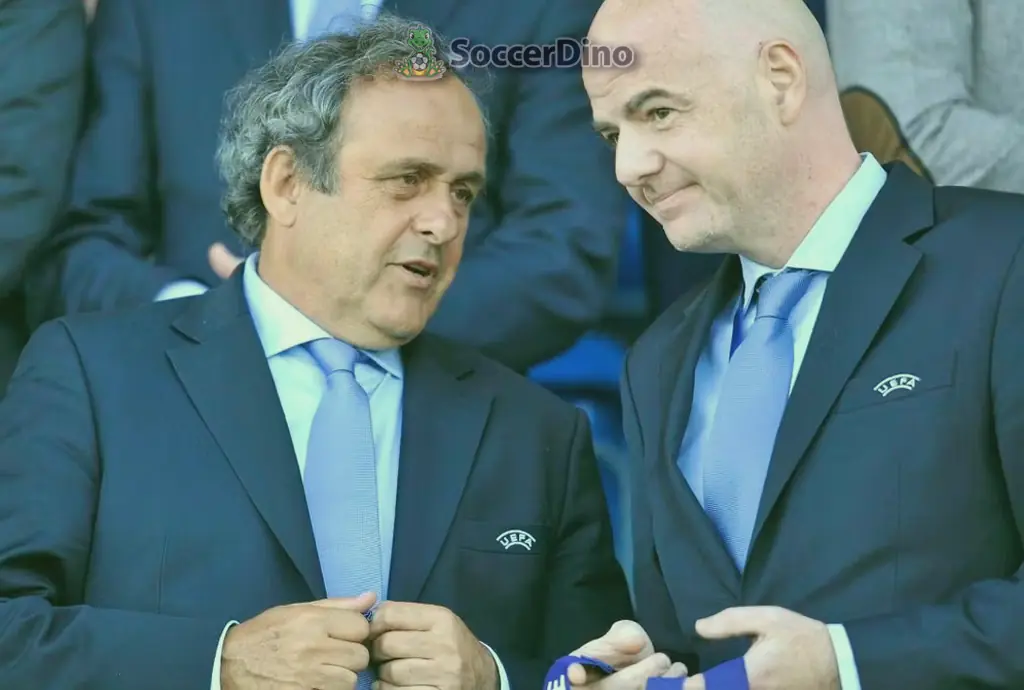
Michel Platini has instructed his lawyers to take action. The three-time Ballon d'Or winner, who worked for FIFA for 13 years, accuses world football's governing body and, among others, Gianni Infantino of deliberately obstructing him around the 2015 presidential election.
Platini Takes New Legal Action Over FIFA Presidency Race
Michel Platini has reopened one of the most sensitive chapters in modern football politics by launching a new legal battle over the collapse of his bid to become FIFA president in 2015. Almost a decade after he was removed from the path that could have taken him to the top of world football, the former UEFA president is now seeking both criminal and civil action, arguing that he suffered serious damage and that the circumstances surrounding his failed candidacy must be investigated.
Platini worked with FIFA between 2002 and 2015, a period during which he became one of the most influential figures in the game. After a legendary playing career with France and Juventus, he successfully moved into football administration and built a powerful reputation at UEFA. For many years, he was seen as a natural successor to Sepp Blatter, especially at a time when FIFA was under increasing pressure to reform after years of controversy, internal tension and corruption allegations.
In 2015, Platini stood as a candidate for the FIFA presidency. His candidacy appeared to carry real weight. He had experience, political support, global recognition and the status of a former football icon. However, his route to the presidency was abruptly blocked after allegations emerged concerning a payment he had received from FIFA. The controversy had immediate and dramatic consequences. It damaged his reputation, derailed his campaign and effectively ended his chances of becoming the most powerful figure in world football.
In the end, it was not Platini who succeeded Blatter, but Gianni Infantino. The Swiss-Italian official, who had previously worked as UEFA general secretary, eventually won the FIFA presidency and began a new era at the organisation. For Platini, however, that moment has never been accepted as a simple political defeat. He believes the events that removed him from the race caused lasting personal, professional and financial damage.
Platini and Blatter were later charged over alleged corruption linked to the disputed payment at the centre of the case. Both men denied wrongdoing. In 2025, they were acquitted by a Swiss court, a verdict that strengthened Platini’s belief that he had been unfairly prevented from pursuing the FIFA presidency. For the former UEFA president, the acquittal did not close the matter. Instead, it appears to have given him new grounds to challenge what happened in 2015.
According to a press release from Platini’s lawyers, obtained by The Athletic and several French media outlets, the Frenchman has now instructed his legal team to file both a criminal complaint and a civil complaint. The civil action is focused on financial compensation for the damage he says he suffered. The criminal complaint seeks an investigation into people Platini believes were involved in eliminating his candidacy from the FIFA presidential race.
The press release contains further allegations and names several high-profile figures. Gianni Infantino, Marco Villiger, who served as FIFA’s legal director between 2007 and 2016, Domenico Scala, who chaired FIFA’s Audit and Compliance Committee between 2013 and 2016, and several Swiss judicial officials are mentioned as people Platini believes should be subject to criminal investigation.
These claims remain allegations from Platini and his legal team. The filing of a complaint does not establish wrongdoing, and it will be up to the relevant authorities to decide whether there are grounds to open a formal investigation. Even so, the decision to name such senior figures makes this a highly significant development. It brings back into public view the political and legal turmoil that surrounded FIFA during one of the most unstable periods in its history.
At the heart of Platini’s position is the belief that he lost far more than an election. He believes he lost the opportunity to lead FIFA at a moment when he was one of the strongest candidates for the role. His legal team is expected to argue that the consequences of the 2015 case went beyond reputational damage. They affected his career, his public standing and his future in football governance.
The case also raises difficult questions for FIFA. The organisation has spent years trying to distance itself from the scandals that surrounded the final years of Blatter’s presidency. Infantino has repeatedly presented his leadership as a period of reform, stability and modernisation. Platini’s new complaint, however, brings attention back to the exact moment when power shifted inside FIFA and asks whether that transition was influenced by actions that should now be examined by criminal authorities.
For Platini, this is not just about the past. It is about responsibility. His legal action suggests that he wants a court or investigative authority to examine whether the process that removed him from the race was fair, transparent and legitimate. He wants to know whether his candidacy was destroyed by the normal functioning of disciplinary and judicial procedures, or whether there were people who acted in a way that unfairly changed the course of FIFA’s leadership battle.
The personal dimension of the dispute is impossible to ignore. Platini was once one of the most admired figures in football, first as a player and later as an administrator. He was a symbol of French football, a three-time Ballon d’Or winner and one of the central figures in European football politics. His fall from the top of the game was sudden and dramatic. From being a serious candidate for the FIFA presidency, he became a figure caught in legal controversy and removed from the centre of football power.
Even after the 2025 acquittal, the damage could not simply be reversed. By that point, the FIFA presidency had long since passed to Infantino, the political landscape had changed and Platini’s opportunity had disappeared. That is why the case remains so important to him. He is not only trying to defend his reputation. He is trying to show that the events which ended his FIFA ambitions had consequences that still matter today.
The civil complaint could become a major test of how much responsibility FIFA may carry for the consequences of the process that affected Platini. If his lawyers can demonstrate that he suffered measurable damage as a result of actions connected to FIFA or its officials, the financial implications could be significant. However, such cases are complex and often depend on proving not only damage, but also a direct link between that damage and the conduct being challenged.
The criminal complaint may be even more sensitive. If authorities decide to examine the allegations, the investigation could revisit internal FIFA decisions, communications and relationships from the period around the 2015 presidential race. That could create serious discomfort for the organisation and for individuals named in the complaint. It would also reopen debate over whether FIFA’s internal governance structures were sufficiently independent during a time of intense political pressure.
For critics of FIFA, Platini’s move may reinforce long-standing concerns about transparency and power inside the organisation. FIFA has often been accused of operating through political alliances, private negotiations and internal mechanisms that are difficult for the outside world to understand. Platini’s complaint touches directly on that issue by questioning whether one of the leading candidates for the presidency was removed from the race through a process that deserves closer legal scrutiny.
For others, the legal action may be seen as an attempt by Platini to revisit a political battle that was lost years ago. His critics may argue that the presidency cannot be returned to him and that football has already moved on. However, the 2025 acquittal gives the former UEFA president a powerful argument: if the criminal case against him ended without conviction, he can now ask why his career and candidacy were so severely affected in the first place.
The dispute is therefore likely to be followed closely across the football world. It combines legal questions, political rivalries, personal reputation and the legacy of one of FIFA’s most turbulent eras. It also places Infantino’s rise to power back under the spotlight, not because any wrongdoing has been established, but because Platini’s complaint directly challenges the circumstances that helped shape the 2016 FIFA election.
For now, the next step will depend on how the relevant authorities respond to the complaints filed by Platini’s lawyers. They will need to decide whether the allegations justify further investigation and whether there is sufficient evidence to examine the conduct of the individuals named. FIFA and the people mentioned may also be expected to respond if the matter advances.
What is already clear is that Platini has not accepted the way his FIFA ambitions ended. Nearly ten years after his presidential campaign collapsed, he is still fighting to challenge the version of events that pushed him out of the race. His demand for compensation and a criminal investigation shows that, for him, the battle over the 2015 FIFA presidency is far from over.