Iran coach Amir Ghalenoei criticises World Cup travel restrictions before the Belgium match and questions why conditions were not eased earlier.
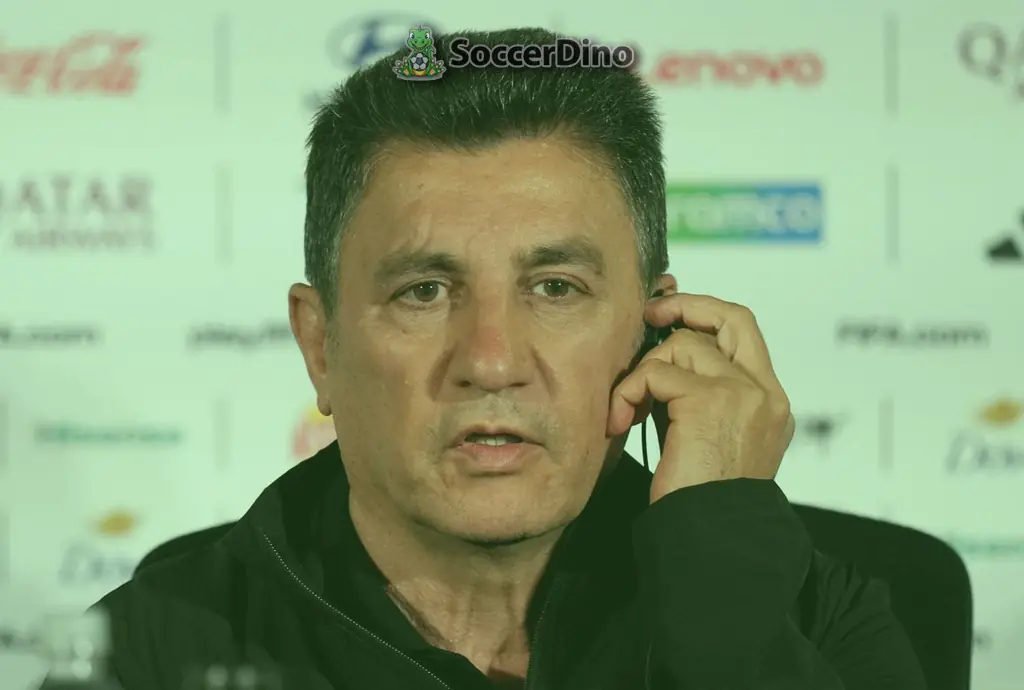
Iran coach renews criticism of travel conditions before crucial Belgium clash
Iran head coach Amir Ghalenoei has once again voiced his frustration over the travel restrictions and preparation conditions faced by his squad during the 2026 World Cup, arguing that his players have not been given the normal working environment expected at a tournament of this magnitude.
Speaking on the eve of the Group G meeting with Belgium, scheduled for this Sunday at 20:00, Ghalenoei revealed that Iran will have more flexibility to organise travel for the final group-stage match against Egypt. That development was welcomed, but it also raised a clear question from the Iranian coach: if a more practical arrangement can now be made for the third fixture, why was the same not possible for the first 2 matches?
The issue has followed Iran throughout the opening phase of the competition. Due to military tensions involving the United States and Israel, the Iranian delegation had only been permitted to enter the United States on World Cup matchdays. After each match, the team had to leave again and return to its base in Mexico within a short time window. For a squad trying to compete at the highest level, that meant reduced recovery, disrupted planning and a major limitation on normal training routines.
For Ghalenoei, the problem is not only logistical. It is competitive. World Cup football is often decided by small margins, and preparation can be the difference between a team arriving organised, fresh and tactically ready, or entering a decisive match under unnecessary pressure. The Iran coach made it clear that the restrictions had affected the way his staff wanted to prepare the players physically and technically.
We were only able to train for the match with Belgium for half the time we would normally devote to training. We wanted to have ideal physical and technical preparation. The conditions became even more difficult than before the opening match against New Zealand. For the third match, they allowed us to decide and organise our own travel, but my problem is this: why did they not let us come earlier for the first 2 matches as well? If they were able to do it now, why did they not do it for our first match and for this match?
The tone of the message was direct, but not entirely confrontational. Ghalenoei was careful to separate his criticism of the conditions from his view of the work being done by FIFA. The Iranian coach acknowledged that football authorities had tried to reduce the impact of the situation and praised the efforts made by FIFA president Gianni Infantino and the organisation to ease the difficulties faced by the delegation.
I know for certain that FIFA and Gianni Infantino are doing everything they can to make these challenges that we are facing easier. I think FIFA did everything to minimise the problems that we had.
That distinction was important. Ghalenoei did not frame his comments as an attack on FIFA. Instead, he placed the emphasis on the practical consequences of the travel arrangement and on the fact that his squad had not been able to work under the same conditions as other teams in the group. In a tournament where preparation time is already limited between matches, losing training hours becomes a significant disadvantage.
The coach also thanked the United States authorities for the way the Iranian delegation was treated once it entered the country. He said the process at customs had been properly managed and that there had been no problem with the actual entry procedure. His frustration, however, remained centred on timing. For Ghalenoei, smooth entry on matchday does not compensate for the inability to arrive earlier, recover properly, train normally and adapt fully to the match environment.
As soon as we entered the United States, they made sure everything went well at customs. I would like to thank the US for that. But unfortunately, they did not give us the time to train.
The comparison with Belgium was unavoidable. According to Ghalenoei, the Belgian squad arrived with enough time to carry out a proper training session and prepare under more conventional conditions. Belgium, already one of the strongest teams in Group G, therefore approach the match with fewer disruptions in the build-up. For Iran, that makes the challenge even greater.
Look at the Belgium team. They arrived yesterday at midday. They were able to train correctly. The Belgian team is very strong and respected, and there is no doubt that it will be a difficult match. But we are also Iranian, and we have good players with great potential.
Those final words showed that, despite the complaints, Iran are not presenting themselves as victims before the match. Ghalenoei wants to underline the difficulty of the situation, but he also wants his players to carry belief into the Belgium game. His message was clear: Iran may have faced unusual obstacles, but the team still believe they have enough quality, discipline and competitive character to fight for a result.
The context of Group G makes the match even more important. Iran began their World Cup campaign with a 2-2 draw against New Zealand, while Belgium also drew 1-1 with Egypt. That means all 4 teams started the second round of fixtures level on 1 point, leaving the group completely open and increasing the pressure on every match. No team has yet created real separation, and every goal could prove decisive in the final standings.
For Iran, the draw with New Zealand offered both encouragement and frustration. Scoring twice in an opening match gave the team something to build on, but failing to secure victory left them with less room for error. Against Belgium, the level of opposition rises sharply. The Belgian squad has individual talent, tournament experience and enough attacking quality to punish mistakes quickly. Iran will need concentration, defensive organisation and efficiency when opportunities appear.
That is why the preparation issue carries such weight. Matches against elite opposition are not only about motivation. They require detailed tactical work, set-piece preparation, recovery management and adjustments based on the opponent. When a team loses training time, the staff have fewer chances to refine details that can later become decisive on the pitch. Ghalenoei clearly believes his side has had to make too many compromises in that regard.
At the same time, the announcement of greater flexibility before the final match against Egypt could become an important turning point. If Iran are able to organise their own travel more freely, the technical team may finally be able to prepare in a more stable way. The Egypt match could be decisive for qualification, especially if Group G remains tight after the second round. In that scenario, recovery, planning and mental clarity will be crucial.
Still, the immediate focus is Belgium. Ghalenoei knows that a strong performance could transform the mood around Iran campaign. A win would put them in a powerful position before the final match, while another draw would keep them alive in a group where balance remains the dominant theme. A defeat, however, would increase the pressure significantly and could leave Iran needing a major result against Egypt.
The Iranian coach is therefore trying to manage 2 battles at the same time. On one side, he is preparing his players for one of the most demanding matches of the group stage. On the other, he is publicly defending the interests of his squad and making clear that preparation conditions have not been equal. His criticism is not only about inconvenience. It is about fairness, competitive integrity and the right of every team to prepare properly for World Cup matches.
Iran will now have to turn that frustration into performance. The players know that the wider debate will not decide the result against Belgium. What happens on the pitch will still depend on discipline, courage and execution. But Ghalenoei remarks have added another layer to a match that already carried major sporting importance.
With every team in Group G still on 1 point after the opening round, the margins are extremely narrow. Iran face Belgium knowing that the result could shape the rest of their tournament. The coach has made his dissatisfaction clear, but he has also made another point just as strongly: Iran still believe they can compete, even under difficult conditions.