Australia beat Turkey 2-0 in Vancouver to open their 2026 World Cup Group D campaign with a disciplined and clinical victory.
Australia Make a Statement as Turkey Return Ends in Frustration
Australia began their 2026 World Cup campaign with one of the most striking results of the opening round, defeating Turkey 2-0 at BC Place in Vancouver and immediately changing the tone of Group D. On a night when Turkey returned to the World Cup stage for the first time since their famous third-place finish in 2002, it was the Socceroos who played with greater clarity, discipline and emotional control.
The result was not just important because of the three points. It carried a much deeper meaning for an Australian side making a sixth consecutive appearance at the tournament and still trying to build a stronger identity on the global stage. Australia have often been respected for their physical strength, organisation and competitive mentality, but this victory showed something more complete: defensive maturity, courage in transition and the ability to punish a technically gifted opponent at decisive moments.
Turkey had more of the ball for long spells and tried to impose their rhythm through players such as Hakan Çalhanoglu, Arda Güler and Orkun Kokçu, but possession alone was not enough. Australia accepted the periods without the ball, stayed compact, protected the central areas and waited for the right moments to break forward. That patience became the story of the match.
Irankunda Gives Australia Belief
The opening goal arrived in the 27th minute and gave the game its defining shift. Nestory Irankunda, one of the most exciting young names in Australian football, finished the move with the confidence of a player who did not look burdened by the size of the stage. His goal put Australia 1-0 ahead and forced Turkey to chase a match they had expected to control more comfortably.
For Australia, the timing of the goal was perfect. Until then, Turkey had been looking to settle into possession and build through midfield, but Irankunda changed the emotional balance of the night. Suddenly, the Socceroos had something to protect, and Turkey had to take greater risks. In World Cup 2026 football, that first goal often changes more than the scoreline. It changes the body language, the tempo and the pressure felt by both teams.
Irankunda brought directness and fearlessness to the Australian attack. His performance was not only about the goal, but also about the message it sent. Australia were not in Vancouver merely to survive. They were there to compete, to hurt Turkey in transition and to show that their younger generation can influence matches at the highest level.
Turkey Control the Ball but Not the Match
Turkey will leave this match with frustration because they had enough possession and attacking talent to create problems, but they never found the composure needed in the final third. Their midfield had technical quality, and the presence of Çalhanoglu and Güler gave them players capable of changing the game with one pass or one moment of inspiration. However, Australia defended with discipline and reduced the space where those players could do real damage.
The Turkish attack became increasingly impatient as the match went on. Crosses were forced, shots were taken under pressure and the final pass often lacked precision. Australia deserve credit for that. Tony Popovic set up his team to suffer without losing structure, and his players followed the plan with impressive concentration.
Patrick Beach, selected in goal for Australia, had a demanding evening and responded with authority. Behind him, the defensive line led by Harry Souttar, Alessandro Circati and Cameron Burgess gave the team a strong base. They dealt with aerial pressure, covered the box well and showed the kind of resilience that often separates good tournament performances from forgettable ones.
Metcalfe Seals the Win
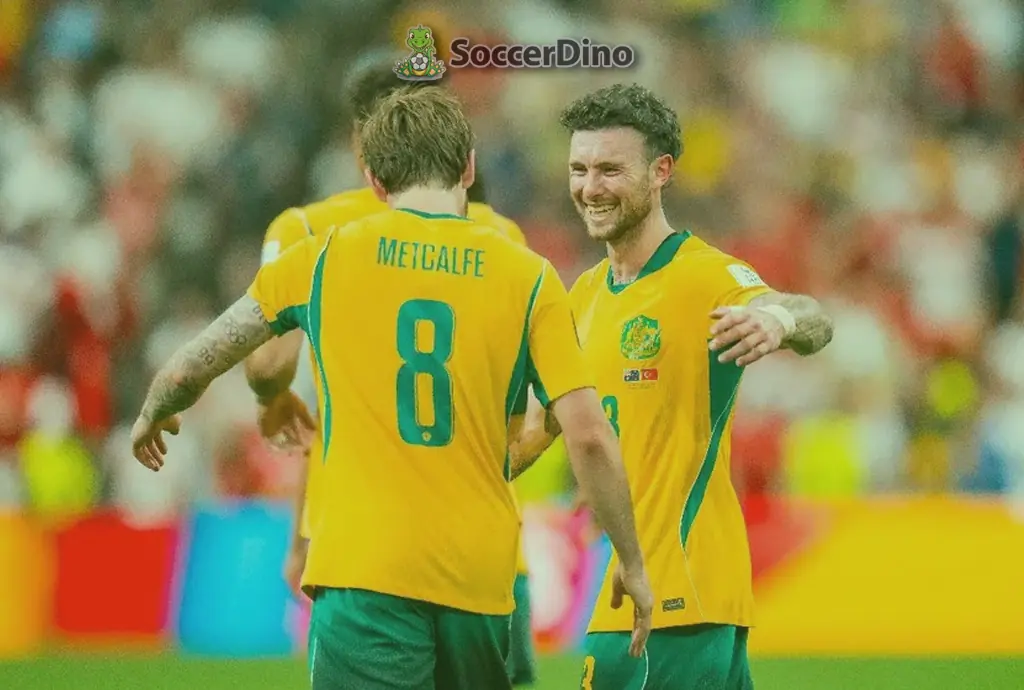
The second decisive moment came in the 75th minute, when Connor Metcalfe made it 2-0 and effectively ended the contest. If Irankunda had given Australia belief, Metcalfe gave them control of the result. His goal arrived at a stage when Turkey were pushing harder, leaving more space and becoming increasingly exposed.
Metcalfe had already been important in midfield, helping Australia compete physically and maintain balance when the team had to move quickly from defence to attack. His goal rewarded a performance full of running, awareness and timing. It also underlined the efficiency of Australia on the night: they did not need to dominate possession to dominate the scoreboard.
At 2-0, Turkey had a mountain to climb. Their substitutions brought fresh legs, with Kenan Yildiz, Yunus Akgün, Salih Ozcan, Mert Muldur and Deniz Gül all introduced, but the rhythm of the match had already slipped away. Australia had grown in confidence, the crowd noise around the Socceroos increased, and the final stages became a test of defensive concentration rather than attacking ambition.
A Victory Built on Discipline
This was only Australia fifth victory in 21 World Cup matches, which makes the result even more significant. For a team from Oceania, every World Cup win carries historic weight, but this one had a particular value because of the opponent, the setting and the context of Group D.
Turkey arrived with expectation. Their return to the tournament after 24 years brought memories of 2002, when they finished third and produced one of the great campaigns in their football history. This squad has talent, technical quality and attacking names capable of troubling many teams. Yet in Vancouver, they were met by an Australian side that refused to be impressed by reputation.
The Socceroos were not spectacular in the traditional sense. They did not control the match through long spells of possession or continuous attacking waves. Instead, they were smart, compact and ruthless. They knew where they could suffer, where they could survive and where they could strike. In tournament football, that combination can be more valuable than style alone.
Group D Takes Shape Early
The result leaves Australia second in Group D with three points, level with co-hosts United States, who opened their own campaign with a 4-1 win over Paraguay. That means the group already has a clear early split: United States and Australia have points on the board, while Turkey and Paraguay are immediately under pressure.
For Australia, the win gives them room to breathe before the next fixtures. Starting a World Cup with three points changes everything. It allows the squad to approach the second match with belief rather than anxiety, and it also gives Popovic more tactical flexibility. Australia do not need to chase the group from behind. They have already placed themselves in a strong position.
For Turkey, the situation is more delicate. A first-match defeat is not fatal, but a 2-0 loss without a goal creates immediate pressure. Their next match will now feel much heavier, because another setback could leave them in serious danger of an early exit. Montella will need to recover confidence quickly and find a way to turn possession into sharper, more efficient attacking football.
Team Details and Match Facts
The match was played at BC Place Stadium in Vancouver, Canada, with 52,497 spectators in attendance. Australia led 1-0 at half-time and completed the victory after the interval, with goals from Nestory Irankunda in the 27th minute and Connor Metcalfe in the 75th minute.
Australia lined up with Patrick Beach in goal, supported by Jacob Italiano, Alessandro Circati, Harry Souttar, Cameron Burgess and Jordan Bos. In midfield and attack, Tony Popovic selected Connor Metcalfe, Aiden ONeill, Paul Okon-Engstler, Nestory Irankunda and Mohamed Touré. During the match, Jason Geria, Nishan Velupillay, Tete Yengi, Aziz Behich and Jackson Irvine were introduced.
Turkey started with Ugurcan Çakir in goal, behind Zeki Çelik, Merih Demiral, Abdulkerim Bardakci and Ferdi Kadioglu. Ismail Yuksek, Hakan Çalhanoglu, Arda Güler, Orkun Kokçu, Baris Yilmaz and Kerem Akturkoglu completed Vincenzo Montella starting side. Turkey made several changes as they searched for a way back into the match, bringing on Kenan Yildiz, Yunus Akgün, Mert Muldur, Salih Ozcan and Deniz Gül.
The referee was Jesús Valenzuela from Venezuela. The only disciplinary note was a yellow card shown to Yunus Akgün in the 86th minute.
A Night That Could Define Australia Tournament
Opening matches can shape the emotional direction of an entire World Cup campaign. For Australia, this was more than a good result. It was a statement of personality. The Socceroos showed they can handle pressure, defend for long periods and still carry enough attacking threat to hurt a strong opponent.
The performance also gave Australia a powerful internal message. Young players such as Irankunda and Beach showed they can deal with the intensity of the World Cup, while experienced figures in the defensive structure provided the stability needed around them. That blend of youth and authority can become one of the most important features of the Australian campaign.
Turkey, by contrast, must now turn disappointment into urgency. They were not without ideas, and they have enough individual quality to recover in the group, but they cannot afford to repeat the same lack of efficiency. In matches of this level, control without penetration is rarely enough. Turkey had possession, but Australia had the moments that mattered.
By the final whistle, the meaning of the night was clear. Australia had not only beaten Turkey 2-0. They had taken a major step forward in Group D, given themselves belief and reminded the tournament that discipline, courage and clinical finishing can still overcome technical superiority. For Turkey, the return to the World Cup began with frustration. For Australia, Vancouver may be remembered as the place where their 2026 campaign truly came alive.