Bayern Munich secured a direct place in the Champions League round of sixteen alongside Arsenal as the league phase standings tightened, with major wins for Liverpool and Real Madrid and Benfica left close to elimination ahead of the final matchday.
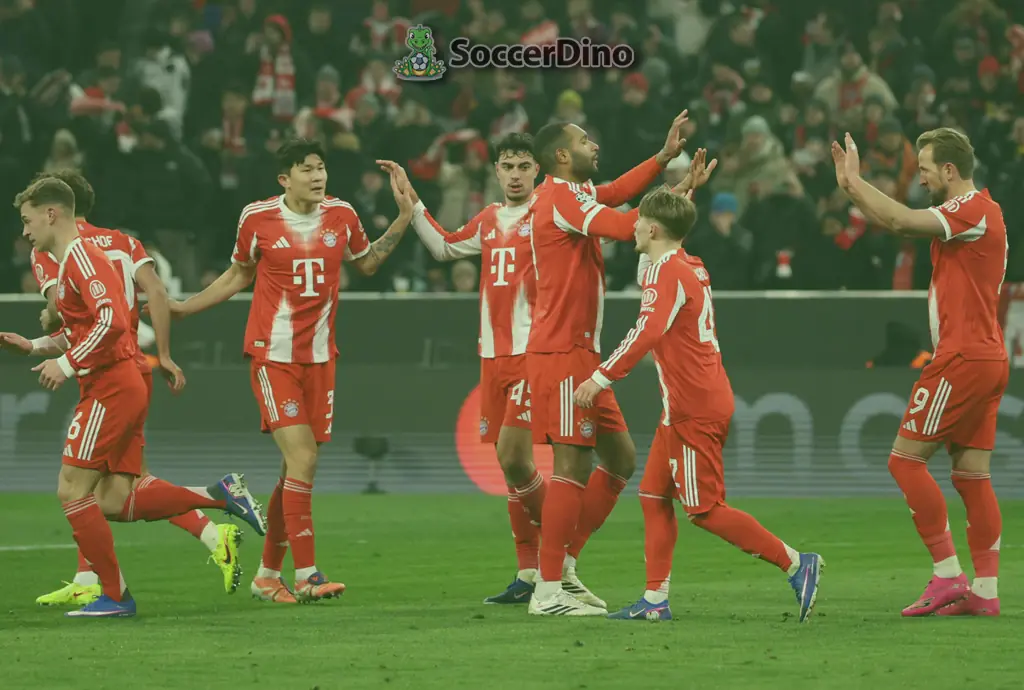
In Munich, Bayern did what elite teams are expected to do when the pressure rises: they produced a controlled home victory, beat Union Saint-Gilloise by two goals to nil, and secured their place among the eight sides that go straight into the round of sixteen without having to navigate the play-off round.
Harry Kane was decisive again, scoring twice in quick succession after the interval. His first brought calm to the game, his second came from the penalty spot, and the scoreline could have been even more emphatic given that he also struck the crossbar when taking another spot kick. Even with the sending-off of Kim Min-jae, Bayern managed the match with the sort of composure that usually separates contenders from the merely competitive.
Beyond the immediate result, Bayern also added another milestone to their European history. They became only the second club to register two hundred and fifty wins in the history of the leading European club competition, including preliminary rounds, a mark previously reached only by Real Madrid, who remain far ahead on three hundred and seven. Raphael Guerreiro started for Bayern, while David Daiber stayed on the bench, a detail that underlined how Bayern’s squad depth continues to shape their approach in a season where domestic priorities and European ambition must be balanced week after week.
Qualification for the round of sixteen was confirmed not only by the victory itself, but by Bayern’s position in the standings. They moved clear in second place with eighteen points, which places them inside the top eight and therefore in the direct-entry positions. Arsenal remain the pace-setters, still perfect, still winning every match, and still sitting three points ahead in first place. That separation at the top matters because it changes the incentives in the final matchday. For Arsenal, the priority is maintaining control of first place and preserving momentum. For Bayern, the priority becomes protecting their direct qualification, avoiding unnecessary complications, and ideally improving their seeding profile, because finishing higher offers a more favourable path in the knockout bracket.
Behind the leaders, the table remains dense, and that congestion is shaping the final matchday into a decisive evening for a large portion of the field. Real Madrid and Liverpool are next, both on fifteen points, and both sending strong messages of their own. Liverpool’s win away to Marseille by three goals to nil stood out not only for its clean scoreline but for the way it combined control with ruthlessness. The goals came from Dominik Szoboszlai, an own goal by goalkeeper Gerónimo Rulli, and a late contribution from substitute Cody Gakpo. In European away matches, that blend of early authority and late punishment is often a sign of a team that understands how to win in different phases of a game.
Real Madrid’s emphatic home win over Monaco by six goals to one a day earlier offered a different kind of statement, more about overwhelming force than match management. In practical terms, it also kept them in the chase pack directly behind the leaders, which means the last matchday still carries significance for them. Even teams with strong European pedigrees do not treat the final round of the league phase as a formality when direct qualification and seeding remain in play.
Tottenham round out the top five with fourteen points, and their position illustrates how fine the margins are for the clubs immediately below the top bracket. They are ahead of a large group sitting on thirteen points, and within that pack, the ordering matters enormously. At this stage, a single win can push a club into a direct round of sixteen place, while a draw or defeat can drop them into the play-off zone, where the margin for error becomes far smaller across a two-legged tie.
Among the teams on thirteen points, three currently occupy direct qualification positions: Paris Saint-Germain, Newcastle, and Chelsea. PSG’s position is particularly striking because their status as reigning European and Intercontinental champions naturally raises expectations that they should not be hovering around the cut-off line. Their defeat away to Sporting by two goals to one on Tuesday added volatility to the situation. It was a reminder that even elite squads can lose points quickly in a format that punishes slip-ups, especially away from home against opponents with a clear plan and a high emotional ceiling.
Newcastle’s win over PSV Eindhoven by three goals to nil was built by the contributions of Yoane Wissa, Anthony Gordon, and Harvey Barnes, and it carried the sort of authority that strengthens a team’s claim for direct qualification. For Newcastle, the broader significance is that performances like that do not just improve their position, they also build belief that they can compete deep into the tournament if they secure a smoother route into the knockout rounds.
Chelsea, meanwhile, did what they needed to do against Pafos, winning by one goal to nil with Moisés Caicedo deciding the match. Pedro Neto played the full game for the world champions, and the night carried an additional storyline because it was their first Champions League match under Liam Rosenior. In a campaign phase where tactical clarity and emotional stability often matter as much as talent, a managerial transition can be either a destabilising factor or a rallying point. Chelsea’s ability to take points without drama could prove crucial if the final matchday turns into a multi-team scramble for direct qualification.
Just outside the direct-entry positions sit Barcelona, in ninth place, which in this format is the most uncomfortable position because it often comes with the feeling of being close yet still having to take the long road. Their win away at Slavia Prague by four goals to two kept them firmly in the hunt. Fermín scored twice, Dani Olmo added a goal off the bench, and Robert Lewandowski also found the net. For Lewandowski, it was particularly notable because he had not scored in the competition this season, and the goal extended his record of scoring in fifteen consecutive seasons in the tournament. Yet the match also produced an unusual personal moment, as he later registered the first own goal of his career, an odd footnote in an otherwise productive evening.
Sporting sit in tenth on thirteen points, and their position has a similar tension to Barcelona’s: they are close to direct qualification, but not yet secure. Manchester City are in eleventh, also on thirteen points, as are Atlético Madrid in twelfth and Atalanta in thirteenth. Atlético’s draw away at Galatasaray by one goal each and Atalanta’s home defeat to Athletic Bilbao by three goals to two highlight how quickly the standings can shift. In a single round, a team can move from a comfortable position into a stressful one, and in the final matchday, every fixture becomes a high-leverage event.
Athletic Bilbao’s situation adds another layer of intrigue because they face Sporting in the final round on the twenty-eighth of January. Their win moved them into the play-off positions and lifted them to twenty-third place, but they remain far from safe. They are part of a cluster on eight points that includes PSV Eindhoven, Olympiacos, Napoli, and Copenhagen. When several clubs are stacked on the same points total, the last matchday becomes about not only winning but also managing goal difference and avoiding damaging defeats that could swing tiebreakers.
Marseille, Bayer Leverkusen, and Monaco sit on nine points, just one below Qarabag and Galatasaray. Qarabag’s comeback win at home to Eintracht Frankfurt by three goals to two was one of the more dramatic results of the matchday, and it further emphasised how the lower half of the table remains alive with teams that still have a route into the play-offs if results break their way.
Further up, Borussia Dortmund sit in sixteenth with eleven points, while Inter Milan and Juventus are slightly better placed on twelve. Juventus’ home win over Benfica by two goals to nil was pivotal for both clubs, but in opposite directions. For Juventus, it strengthened their position and pushed them closer to safety. For Benfica, it was a heavy blow, compounded by the missed penalty from Vangelis Pavlidis late on, and it represented their fifth defeat in the competition. Francisco Conceição featured in the second half, while João Mário remained on the bench, but the broader reality for Benfica is that their campaign now depends on a highly unlikely combination of outcomes.
Benfica go into the final matchday in twenty-ninth place with six points, level with Bodo/Glimt, Pafos, Union Saint-Gilloise, and Ajax. Club Brugge sit just above them with seven. That gap may look small, but at this stage of the league phase it is enormous because there are not enough points left for gradual recovery. Benfica’s final fixture, at home to Real Madrid, is among the most difficult assignments available, and that context is what makes their path so narrow. Even if they were to produce an exceptional result, they would still need other matches to fall in a very specific pattern to lift them into the play-off positions.
The overall elimination picture is also sharpening. All teams up to fifteenth are already through to the knockout rounds, while Eintracht Frankfurt, Slavia Prague, Villarreal, and Kairat Almaty, the bottom four, are already out. That clarity at both ends increases the pressure in the middle, where the majority of clubs are fighting either for direct qualification or simply for a play-off place.
The final matchday of the league phase is designed for maximum drama: eighteen matches played simultaneously on the twenty-eighth of January, removing the possibility of teams reacting to earlier results and forcing everyone to play without knowing exactly how the broader table will land. Two days later comes the play-off draw, and the play-offs themselves are contested over two legs in February. The winners of those eight ties then join the directly qualified teams in the round of sixteen, which is scheduled for March.
In that sense, this matchday did two things at once. It confirmed the first wave of direct qualifiers, with Bayern joining Arsenal at the top, and it intensified the pressure on clubs like Benfica whose margins have effectively disappeared. The next round will not simply decide who advances. It will decide who earns the advantage of a smoother route, who is forced into a dangerous extra tie, and who sees their European season end before the knockouts even begin.