Radja Nainggolan, now at Patro Eisden, reflects on a career often surrounded by controversy and says he wouldn’t change his lifestyle even after being told he could have played for Real Madrid. He also recalls strict moments at Roma under Luciano Spalletti and explains what led to his departure and eventual move to Inter.
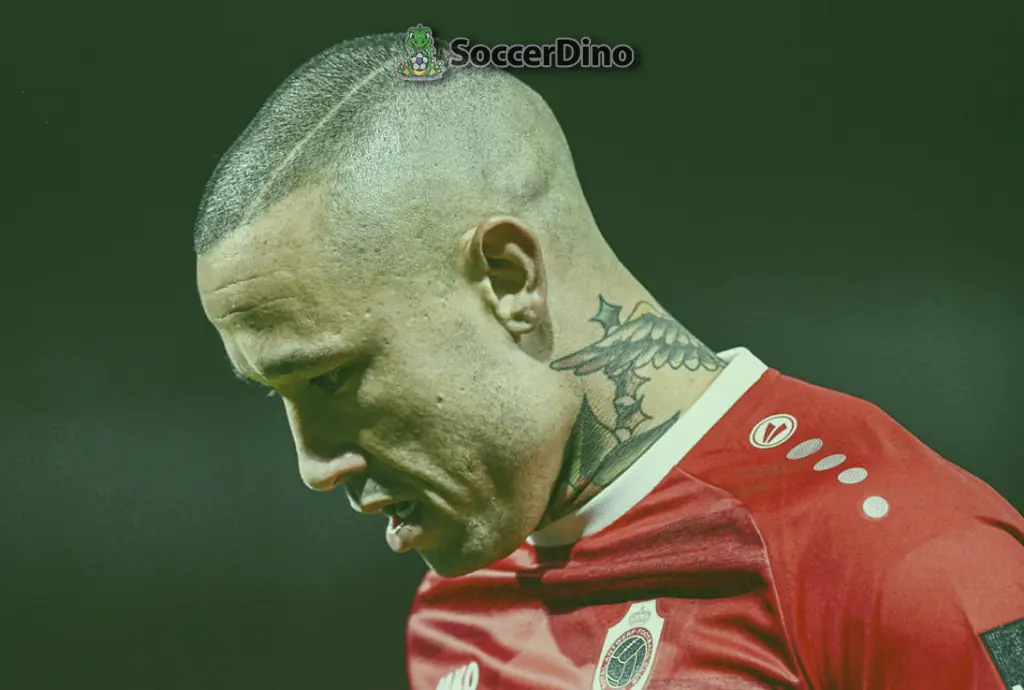
Radja Nainggolan now finds himself playing for Belgian side Patro Eisden, a long way from the elite stages where he once built a reputation as one of Europe’s most intense and distinctive midfielders.
At 37, he is no longer a weekly presence in the biggest leagues, but his name still carries weight because of what he was at his peak and because his career was so often framed by the same storyline: a player with undeniable talent and personality, but also a lifestyle and a temperament that repeatedly pulled attention away from his football.
Speaking on the Sportium.fu podcast, Nainggolan leaned into that duality, addressing head-on the idea that his off-pitch habits limited how far he could have gone. He said he was told that if he had lived differently, he could have reached the very top, even claiming that people around the game believed a more disciplined version of himself could have played for Real Madrid. Rather than deny it, he accepted the premise but rejected the conclusion that he should have changed, insisting that his lifestyle was part of what made him who he was and that stripping it away would have damaged his happiness and, by extension, his performances.
“They told me that if I didn’t drink or smoke, I could play for Real Madrid, but without my lifestyle, I wouldn’t have been happy and I wouldn’t have performed the way I did,” he said. The remark captures a familiar tension in elite sport, where small margins separate the very best careers from those that are defined by “what ifs.” Nainggolan’s point was not that discipline is unnecessary, but that his personality, habits, and footballing identity were intertwined. In his view, he delivered at a high level precisely because he lived in a way that suited him, even if it sometimes brought criticism or controversy.
That controversy has followed him across clubs and countries, and Nainggolan did not avoid it when revisiting his time at Roma, the club where he arguably reached his most consistent level and became a fan favourite for his work rate, aggression, and ability to combine grit with technical quality. His years in the capital were also shaped by his relationship with Luciano Spalletti, and Nainggolan shared an anecdote that underlined how far the club and coach were willing to go to keep him focused and under control.
According to Nainggolan, Spalletti once insisted he stay overnight at Trigoria, Roma’s training centre, essentially to remove the temptation to go out. He described it less as a punishment and more as a measure driven by the coach’s fear that he would slip away into the night. “The coach [Luciano Spalletti] used to lock me in at Trigoria at night. I don’t remember exactly why. He told me, ‘Sleep here this week because I don’t want you going out.’ He slept in the room next door and every night, until 10:30 p.m., he came to check on me because he was afraid I’d sneak out,” he recalled. The image is striking: a top-level coach personally monitoring a key player, not over tactics or recovery, but over behaviour, in an attempt to protect both the squad and the player from another headline.
The story also hints at the complicated dynamics that can exist between managers and high-profile, high-risk personalities. Nainggolan was a key piece on the pitch, but one who, by his own admission, came with concerns that required constant management. For some coaches, that kind of oversight becomes an exhausting necessity; for others, it’s the price of having a difference-maker in the team. Nainggolan’s telling suggests Spalletti saw enough value in him to commit to that effort, even if it meant an unusual level of supervision.
Nainggolan’s Roma chapter also connected directly to another turning point in his career: his departure and the sense that he was pushed out for reasons that went beyond purely sporting considerations. He explained that he could have remained at the club, but the arrival of Monchi, a sporting director with a clear vision and a desire to reshape the squad, changed the atmosphere. Nainggolan painted it as a clash of control and identity, where a new executive wanted to move on from the previous regime’s players and impose his own authority. He referenced Walter Sabatini, the former sporting director, and suggested that Monchi’s priority was to sell the players associated with the old structure.
“I could have stayed, but then sporting director Monchi arrived and wanted to build his own team. The Sevillian genius believed he could build a team in Italy in his own way. He wanted to sell all of Sabatini’s players,” Nainggolan said. He went further, implying he refused to accept a situation in which he would be treated as disposable or expected to play along with what he saw as insincere relationship-building. “When I found out, I told him I would decide where I was going. I could have stayed, but I told him I couldn’t greet him every day. He wanted to pretend he was a friend,” he added.
That perspective frames his subsequent move to Inter in 2018/19 as less of a straightforward transfer and more of a statement. Nainggolan’s version suggests he wanted agency, not simply an exit route, and that he preferred to choose his next step rather than be managed out quietly. Inter, at the time, offered him a return to a familiar environment in Italy and a chance to remain relevant at the top level, but it also marked the beginning of a later phase of his career where stability became harder to find and the spotlight he once carried began to fade.
Now, with Patro Eisden, the contrast with those Serie A nights is stark. The grounds are smaller, the media attention is lower, and the margins of fame have shifted. Yet Nainggolan’s words make it clear he is not presenting himself as a cautionary tale, at least not in the conventional sense. He is not claiming innocence, and he is not insisting he was misunderstood. Instead, he is offering a kind of blunt self-assessment: he made choices, those choices shaped his career, and he would rather have lived as himself and performed as he did than chase an ideal version of success that would have left him unhappy.
In that sense, the Real Madrid line is less about regret and more about identity. For many players, being told they “could have played for Madrid” is the ultimate compliment and the ultimate sting, because it implies a ceiling they never reached. Nainggolan flips it into something closer to defiance, arguing that the pursuit of that ceiling would have required him to become someone else. Whether fans see that as honesty, stubbornness, or justification depends on how they view the trade-off between professionalism and personal freedom, but it is undeniably consistent with the player he was: talented, intense, and never particularly interested in being moulded into a standard template.
Even years after his peak, Nainggolan remains a figure who prompts debate, and his reflections show why. His career offered elite performances, big clubs, and iconic moments, but it also came with friction, headlines, and decisions that still provoke “what if” conversations. From his point of view, though, the story is simpler. He played the way he played, lived the way he lived, and believes that, for better or worse, it was the only way he could have been Radja Nainggolan.