Leandro Paredes did not receive a red card in the aftermath of the World Cup final between Spain and Argentina, contrary to earlier reports. Sources within FIFA confirmed this to several English media outlets.
Paredes could still face punishment after World Cup final controversy
Leandro Paredes could still face disciplinary action following the chaotic scenes that unfolded after Spain’s 1-0 victory over Argentina in the World Cup final. The experienced midfielder was involved in a heated confrontation immediately after the final whistle, but reports that he had already been shown a red card have now been called into question.
Tempers flare after Spain’s World Cup triumph
Spain were crowned world champions after defeating Argentina in a fiercely contested final that was decided in extra time. Ferran Torres scored the decisive goal, ending Argentina’s hopes of retaining their place at the summit of international football and sparking emotional celebrations among the Spanish players, staff and supporters.
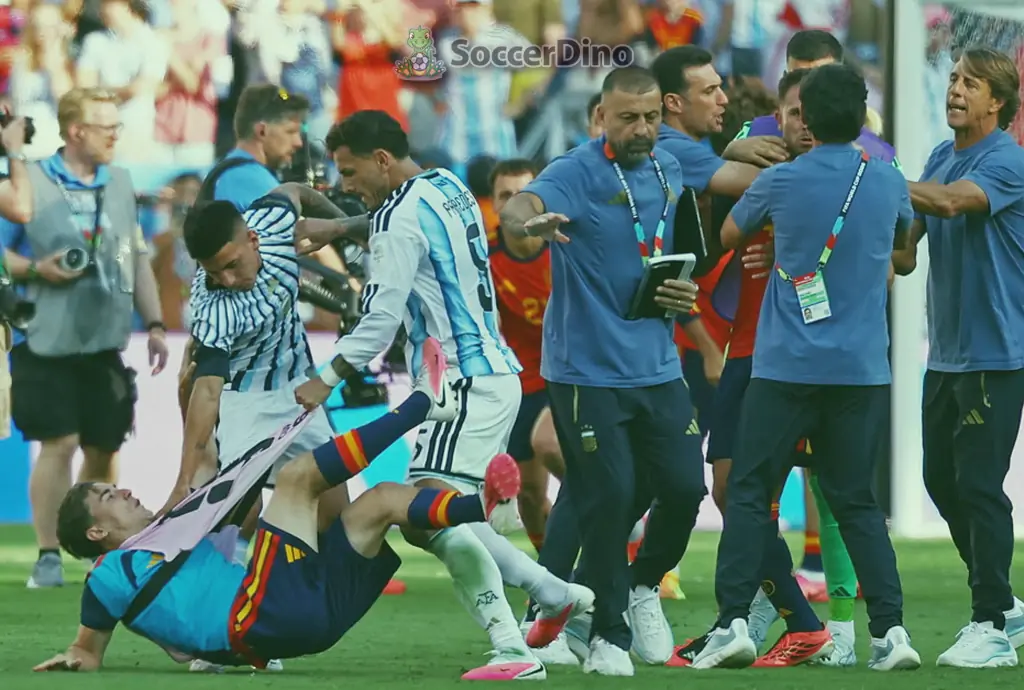
While Spain celebrated one of the greatest achievements in the country’s football history, frustration quickly boiled over within the Argentine camp. Several confrontations took place on the pitch in the moments after the match, with Paredes at the centre of the most controversial incident.
The 32-year-old Boca Juniors midfielder approached Spanish defender Eric García during the post-match disorder and grabbed him by the throat. Paredes was also seen pushing Spain substitute Gavi to the ground while holding him by his training bib.
The images spread rapidly across television broadcasts and social media, leading to widespread criticism of the Argentine midfielder’s conduct. Many observers felt that the reaction went far beyond the normal disappointment associated with losing a major final, particularly given that the match had already ended and Spain’s players were beginning their celebrations.
Confusion surrounding reported red card
Initial reports suggested that referee Slavko Vinčić had shown Paredes a red card following the confrontation. The general assumption was that the midfielder had been formally dismissed for violent or improper conduct after the final whistle.
However, that version of events was later challenged. Paredes’ alleged red card did not appear on the official match page published by FIFA, creating uncertainty over whether the referee had actually sanctioned the player at the stadium.
The dismissal was also missing from Vinčić’s official match report. According to reports from the BBC and The Independent, sources within FIFA confirmed that Paredes had not been officially shown a red card, despite the earlier claims that circulated following the final.
The absence of the dismissal from both FIFA’s match page and the referee’s formal report is significant. Disciplinary decisions made by the referee are normally recorded in the official documentation, particularly when they involve a red card in a match as important as a World Cup final.
It remains unclear how the initial reports emerged or whether there was confusion during the disorder on the pitch. With several players, substitutes and members of staff involved in separate incidents, it is possible that the situation was incorrectly interpreted by those watching from a distance.
FIFA opens disciplinary investigation
Although Paredes was apparently not dismissed by the referee, the midfielder is not necessarily safe from punishment. FIFA has opened a disciplinary investigation into the conduct of members of the Argentine team following the final.
The investigation is expected to examine video footage, official reports and any additional evidence relating to the confrontations after the final whistle. FIFA’s disciplinary bodies can impose sanctions even when an incident was not punished by the match officials at the time.
This means Paredes could still receive a suspension or another disciplinary penalty if FIFA determines that his actions breached the organisation’s regulations. The fact that the confrontation took place after the match does not prevent the governing body from taking action.
Post-match misconduct remains subject to FIFA’s disciplinary jurisdiction, particularly when players or staff members are accused of violent behaviour, threatening opponents or damaging the reputation of the competition.
Molina and Ayala also under scrutiny
Paredes was not the only Argentine figure whose behaviour attracted criticism. Right-back Nahuel Molina and assistant coach Roberto Ayala were also accused of misconduct during the tense scenes that followed Argentina’s defeat.
The involvement of several members of the Argentine delegation has made the matter more serious for FIFA. Rather than dealing with a single isolated confrontation, the governing body must now assess a wider sequence of incidents involving players and coaching staff.
FIFA could choose to examine each case individually before determining whether sanctions are appropriate. Any punishment would depend on the evidence available, the precise nature of the conduct and the disciplinary history of those involved.
Argentina’s disappointment was understandable after losing a World Cup final in extra time, but the scenes after the match have overshadowed the team’s performance and attracted criticism from around the football world.
Spain’s celebrations overshadowed by disorder
For Spain, the victory should have been remembered exclusively as a historic sporting achievement. Ferran Torres’ extra-time goal delivered the World Cup and secured a dramatic 1-0 win over one of international football’s most successful teams.
Instead, part of the immediate discussion surrounding the final focused on the confrontations involving Paredes and other members of the Argentine camp. The disorder interrupted the celebrations and created an uncomfortable conclusion to the tournament’s most important match.
Eric García and Gavi were among the Spanish players directly involved in the altercation. The footage of Paredes grabbing García and pushing Gavi became one of the most widely discussed moments from the aftermath of the final.
Neither the intensity of the match nor the disappointment of defeat is likely to be considered a sufficient justification for the behaviour. FIFA has repeatedly sought to protect players and officials from confrontations that continue after the final whistle.
Paredes now awaits FIFA’s decision
Paredes must now wait for the outcome of the disciplinary process. The midfielder may be asked to provide his version of events, while Argentina’s football authorities could also be invited to respond to the allegations concerning their players and staff.
The fact that no red card was officially recorded may affect the procedural details of the case, but it does not remove the possibility of a retrospective sanction. Video evidence could prove decisive, especially because the confrontation was captured clearly and broadcast internationally.
FIFA has not yet announced what punishment, if any, will be imposed. The governing body will first need to complete its investigation and determine whether the actions of Paredes, Molina, Ayala or any other individual violated its disciplinary rules.
Until a final decision is issued, the controversy surrounding Paredes will remain unresolved. What appears certain is that the midfielder’s conduct after Argentina’s defeat has placed him under intense scrutiny and could yet result in serious consequences, despite the absence of an official red card from referee Slavko Vinčić’s match report.