FIFA faced intense criticism at the 2026 World Cup over the Balogun red card ruling, political interference, travel restrictions and international disputes.
Balogun Red Card Controversy and Political Tensions Overshadow 2026 World Cup
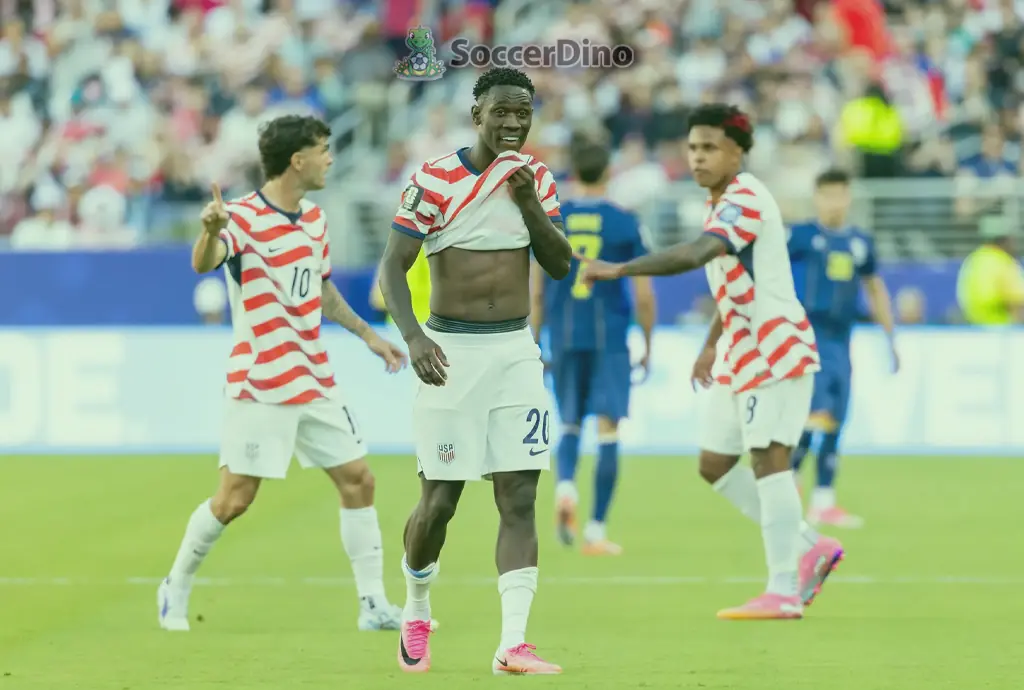
The decision to allow United States forward Folarin Balogun to continue playing after his red card against Bosnia and Herzegovina became one of the most controversial moments of the 2026 World Cup, a tournament repeatedly affected by political disputes, immigration restrictions and accusations of unequal treatment.
An Unprecedented Decision After Balogun Red Card
Balogun was dismissed during the United States 2-0 victory over Bosnia and Herzegovina in the Round of 32 after making a dangerous challenge on defender Tarik Muharemović.
The incident initially escaped a severe punishment from Brazilian referee Raphael Claus, but the video assistant referee advised him to review the challenge on the pitchside monitor.
After watching the replay, Claus changed his decision and showed Balogun a straight red card. Under normal circumstances, the dismissal would have automatically ruled the forward out of the following match, with the possibility of a longer suspension depending on the severity of the offence.
However, FIFA later announced that Balogun would not have to serve the suspension immediately. Instead, the punishment was suspended for a one-year probationary period, allowing him to remain available for the United States Round of 16 match against Belgium.
The decision was described as unprecedented and immediately raised questions about the consistency of FIFA disciplinary process. Players sent off for serious foul play are normally suspended for at least one match, even when disciplinary officials later decide that the challenge did not justify a longer ban.
Critics argued that FIFA had effectively accepted the validity of the red card while removing its most immediate consequence. That interpretation created confusion among national federations, former referees and football officials who demanded a clear explanation of the legal basis for the ruling.
FIFA said the punishment remained active but would only be enforced if Balogun committed another comparable offence during the probationary period. The explanation did little to reduce the criticism.
Several observers questioned why the same mechanism had not been used in previous tournaments and whether players from other countries would have received identical treatment.
The controversy became significantly more serious when United States President Donald Trump confirmed that he had personally asked FIFA president Gianni Infantino to reconsider the dismissal.
Trump publicly suggested that Balogun had been treated unfairly and revealed that he had raised the matter directly with Infantino. The admission transformed what had initially been a disciplinary debate into a much wider controversy about political influence over football decisions.
The timing was particularly damaging for FIFA. The tournament was being co-hosted by the United States, Mexico and Canada, and the American national team had reached the knockout stage with considerable attention from the domestic public.
Allowing a key United States player to avoid suspension after the intervention of the American president created the impression that the host nation had received preferential treatment.
UEFA and European Federations React
The Belgian Football Association was among the first organisations to respond strongly. Belgium were preparing to face the United States in the next round and believed Balogun should have been suspended under the standard disciplinary regulations.
Belgian officials formally protested the decision and requested further clarification from FIFA. The federation argued that changing the practical consequences of the red card altered the competitive conditions of the match.
Belgium eventually agreed to play but did so under protest, ensuring that its objections were officially registered before kick-off.
UEFA also intervened, accusing FIFA of having crossed a red line. The European governing body warned that direct political pressure on disciplinary decisions threatened the independence and credibility of football institutions.
The unusually strong public language reflected the seriousness with which UEFA viewed the case. Relations between FIFA and UEFA had already been tense over several issues, including the international calendar, the expansion of competitions and the balance of power within global football.
The Balogun ruling added another dispute. UEFA officials argued that disciplinary processes must remain protected from governments, national associations and tournament hosts.
Germany, the Netherlands, Norway and Switzerland also criticised the decision. Their reactions extended the controversy beyond the two national teams directly involved.
Officials from those countries questioned whether FIFA could guarantee equal treatment for all participants when the president of a host nation was able to contact the organisation leader about a specific player.
The debate also reached former players, referees, legal experts and human rights organisations. Many condemned the appearance of political interference, even among those who believed the original red card may have been too severe.
The central argument was that the correctness of the sending-off and the independence of the disciplinary process were separate issues.
FIFA could have reviewed the decision through established procedures. The involvement of Trump, followed by an exceptional ruling favourable to an American player, created doubts that were difficult to dismiss.
Balogun eventually started against Belgium, but his availability did not change the outcome. Belgium produced one of their strongest performances of the tournament and defeated the United States 4-1.
The European side controlled the match for long periods and punished the American defence repeatedly. The result eliminated the co-hosts and ensured that the disciplinary dispute did not affect which team progressed to the quarter-finals.
Nevertheless, the controversy did not disappear with the United States elimination. For many observers, the case had already damaged FIFA reputation and created a dangerous precedent for future competitions.
Infantino Relationship With Trump Under Scrutiny
The close relationship between Donald Trump and Gianni Infantino had been visible long before the tournament began.
Infantino appeared alongside Trump at several public events connected to the World Cup and repeatedly praised the role of the United States in staging the expanded competition.
FIFA depended heavily on cooperation from the American government to organise security, immigration procedures, diplomatic access and transportation across the tournament.
However, critics believed the relationship had become too personal and politically sensitive.
In December 2025, Infantino presented Trump with FIFA newly created Peace Prize. The award immediately attracted controversy, with opponents questioning both the selection process and the decision to associate the governing body so closely with a serving political leader.
The prize had no significant history within FIFA and was widely interpreted as a gesture designed specifically for Trump.
When the Balogun case emerged several months later, those earlier concerns returned. Critics argued that the disciplinary decision could not be considered in isolation from the public closeness between the two men.
FIFA denied that political pressure had determined the outcome, maintaining that the case had been assessed by the appropriate disciplinary bodies.
Even so, the organisation struggled to convince its critics. The absence of a clear precedent and the public confirmation of Trump intervention made the ruling appear extraordinary.
Infantino also faced criticism for his constant presence throughout the tournament. He appeared at numerous matches in different cities, sometimes attending more than one game on the same day despite the enormous distances between venues.
His frequent appearances in stadiums became part of the wider discussion about FIFA leadership style. Supporters said it was natural for the president to attend the organisation most important competition, while critics described his presence as excessive and carefully designed for maximum visibility.
Even his reactions in the stands were analysed. Television cameras regularly focused on Infantino during controversial incidents, major goals and national anthems.
Some commentators accused him of behaving more like a political figure than the administrator of an international sporting body.
The series of controversies briefly created uncertainty about the level of support available for his expected re-election in March of the following year.
Several federations that had previously appeared certain to support him became more cautious in public. However, there was still little indication that a serious challenger would emerge or that his position was under immediate threat.
Iran Compete During Conflict With the United States
The political tension surrounding the tournament went far beyond the Balogun case.
Iran participation became one of the most sensitive issues of the competition because the national team travelled to North America during a military conflict involving the United States.
While Iranian players were preparing for World Cup matches, tensions between the two countries continued to increase. Reports of possible new attacks dominated international news, and military action eventually took place during the tournament.
The situation placed the Iran delegation in an extraordinary position. The team had qualified for its seventh World Cup but was required to play every group match in the country involved in the conflict.
At one stage, there were serious doubts about whether Iran would be able or willing to participate.
The team eventually travelled but changed its original plans. Instead of establishing its main training base in the United States, Iran chose to operate from Mexico.
The decision reduced the amount of time the delegation would spend on American territory, but it also created logistical complications.
Players and officials had to travel repeatedly between Mexico and the United States for matches, passing through immigration and security procedures each time.
Several members of the delegation faced restrictions, delays or refusals when attempting to enter the country. Iranian officials accused the United States of applying discretionary rules and deliberately making the team preparations more difficult.
Some members of the wider travelling party were prevented from entering entirely, reducing the number of staff available to support the players.
The Iranian federation repeatedly requested FIFA intervention. It argued that all qualified teams were entitled to compete under equal conditions, regardless of diplomatic relations between their governments.
FIFA maintained that it was working with the host authorities, but Iranian officials believed the response was insufficient.
Captain Mehdi Taremi became one of the strongest public critics of the situation.
The former FC Porto and Rio Ave forward was questioned by United States authorities before one of Iran matches. The interrogation reportedly focused on travel history, political connections and the circumstances surrounding the team presence in the country.
Taremi later accused FIFA and the United States of creating conditions designed to ensure that Iran would be eliminated as early as possible.
Iran were eventually knocked out during the group stage, adding to the sense of frustration surrounding their campaign.
The team left a message in its dressing room that attracted considerable attention after the elimination.
“We come from Iran, a land that for thousands of years has placed honour above victory. For us, football is not only a competition for results, it is a test of character. Points may perhaps be won in many ways, but respect cannot,” the message read.
The statement reflected the Iranian view that their World Cup experience had been about more than results. Players and officials felt they had been required to compete while dealing with conditions that no other team faced.
For FIFA, the episode demonstrated the difficulty of presenting football as politically neutral while organising a global event during an active international conflict.
Travel Restrictions Affect Players and Officials
Iran were not the only team affected by immigration and border controls.
The geographical scale of the tournament required teams to travel regularly between the United States, Canada and Mexico. Different immigration systems and entry requirements created complications throughout the competition.
Switzerland forward Breel Embolo was one of the players affected. He was unable to travel with the rest of the Swiss squad as originally planned and joined the group later.
The delay disrupted his preparation and raised concerns about whether immigration procedures were being handled consistently across the three host countries.
Ghana midfielder Thomas Partey faced a more serious problem. Ghana were coached by Portuguese manager Carlos Queiroz and were due to begin their campaign against Panama in Canada.
Partey was prevented from entering Canadian territory and missed the opening match.
The midfielder was facing rape allegations in England, and Canadian authorities refused him entry after reviewing his legal situation.
The decision placed Ghana in a difficult sporting position shortly before the start of the match. Queiroz had prepared with Partey as one of the most experienced members of the squad, but was forced to reorganise his midfield.
Canadian officials defended the decision as a matter of domestic immigration law rather than football policy.
However, the case again highlighted the complications of holding one competition across three countries with different legal systems.
Teams could be permitted to enter one host nation while being denied access to another, even when qualification required them to play in both.
Somali Referee Refused Entry After Landing in Miami
The most symbolic immigration controversy involved Somali referee Omar Abdulkadir Artan.
Artan had been included on the final list of referees selected for the World Cup and travelled to the United States expecting to participate in the tournament.
After landing in Miami, he was detained and questioned for several hours by immigration authorities.
Despite possessing the documents required for his official role, he was refused entry and forced to return.
The incident caused widespread criticism because Artan had been selected directly by FIFA to work at its most important competition.
Referees normally travel under arrangements coordinated between FIFA, local organising committees and national governments. His exclusion suggested a serious breakdown in that process.
FIFA expressed disappointment but was criticised for failing to prevent the situation or secure his return.
Several organisations argued that the governing body should have demanded stronger guarantees from the host countries before awarding them the tournament.
UEFA later appointed Artan to referee the European Super Cup between Paris Saint-Germain and Aston Villa on 12 August.
The European governing body said football had the purpose of bringing people together, language widely interpreted as a response to his treatment in the United States.
The appointment carried both sporting and symbolic significance. It placed Artan in charge of one of the first major European matches of the new season and publicly demonstrated UEFA confidence in his abilities.
It also added another point of tension between UEFA and FIFA during a period already dominated by the Balogun controversy.
Argentina Banner Creates Another International Dispute
Political controversy returned during the closing stages of the tournament when Argentina faced England in the semi-finals.
Argentina won the match 2-1 to reach the World Cup final, but an image displayed by the South American team generated international attention.
Argentine players appeared on the pitch with a banner carrying the message: “The Malvinas are Argentine.”
The statement referred to the long-running sovereignty dispute between Argentina and the United Kingdom over the islands known in Argentina as the Malvinas and in Britain as the Falkland Islands.
The two countries fought a war over the territory in 1982, and the issue remains politically sensitive more than four decades later.
The banner immediately transformed the semi-final into a diplomatic issue. British officials condemned the message and asked FIFA to investigate whether Argentina had violated tournament regulations.
FIFA rules restrict political messages during matches and official ceremonies. National teams can face fines or other disciplinary measures when players or officials display political slogans inside stadiums.
Argentina supporters argued that the banner reflected a national position shared across the political spectrum in their country.
British critics responded that a World Cup semi-final was not an appropriate setting for a sovereignty claim, particularly in a match against England.
The incident once again forced FIFA to decide where to draw the line between national identity and political expression.
Any disciplinary response was certain to be closely compared with the organisation handling of earlier controversies.
After the exceptional treatment given to Balogun, FIFA was already facing accusations that its rules were not applied equally to every federation.
A Historic Tournament Overshadowed by Events Away From Football
The 2026 World Cup was historic before the first match was played.
It was the first edition to feature 48 national teams, expanding the competition from the previous 32-team format.
The tournament began on 11 June and ended on Sunday, with matches staged across the United States, Mexico and Canada.
The expanded format introduced a Round of 32 and created the largest World Cup schedule in history.
More countries received the opportunity to participate, while supporters travelled across a vast geographical area to follow their national teams.
On the pitch, the tournament produced dramatic knockout matches, unexpected eliminations and a final between Spain and Argentina.
However, many of the defining stories occurred away from the football itself.
The Balogun disciplinary decision raised questions about political influence and the independence of FIFA judicial bodies.
Iran experience exposed the difficulties of organising a supposedly universal competition during a military conflict involving one of the host nations.
The cases involving Embolo, Partey and Artan showed how immigration policy could directly affect sporting participation.
The Argentina banner demonstrated that historical disputes could quickly enter the stadium and become part of the tournament narrative.
Each incident was different, but together they created a common concern about governance, fairness and consistency.
FIFA repeatedly presented the World Cup as an event capable of uniting countries through football. Yet the competition also showed that the sport cannot always separate itself from international politics.
With 48 teams, three host nations and millions of travelling supporters, the tournament depended on decisions made not only by coaches and referees but also by governments, immigration officials and political leaders.
The controversy surrounding Balogun became the clearest example of those worlds colliding.
A challenge on the pitch led to a red card. The red card led to a disciplinary review. The review involved the president of the United States, the president of FIFA, UEFA and several national federations.
By the time Belgium eliminated the United States, the issue had become far larger than the player or the match itself.
Balogun started against Belgium, but the debate over why he was allowed to play continued long after the final whistle.
For critics, the decision represented evidence that powerful countries and political leaders could influence football institutions.
For FIFA, it became another test of credibility during a tournament in which its leadership was under almost constant scrutiny.
The 2026 World Cup will be remembered for its expanded format, its enormous scale and the football played across North America.
It will also be remembered as a competition in which disciplinary decisions, border controls, military conflict and diplomatic disputes repeatedly competed with events on the pitch for international attention.