Philippe Diallo challenges Gianni Infantino for the FIFA presidency in March 2027, backed by UEFA and calling for greater transparency and governance reform.
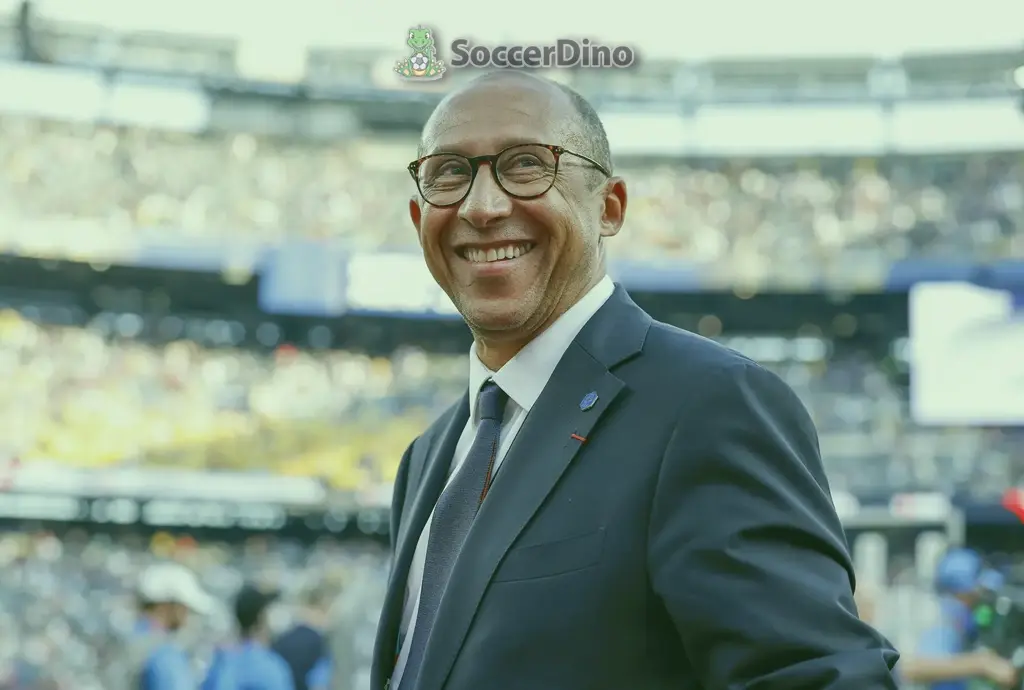
Philippe Diallo Challenges Gianni Infantino for FIFA Presidency After Securing UEFA Support
Philippe Diallo has officially entered the race to become the next FIFA president, setting up a major challenge to Gianni Infantino ahead of the elections scheduled for March 2027. The president of the French Football Federation (FFF) confirmed his candidacy on Tuesday, November 17, after receiving unanimous approval from his federation's Executive Committee and strong backing from UEFA.
The decision represents a significant development in the growing dispute over the leadership of world football. Infantino, who has been in charge of FIFA since February 2016, is seeking another four-year term, but his presidency has come under increasing scrutiny following a series of controversial decisions and disagreements with several of football's most influential governing bodies.
Diallo, 63, has emerged as the principal candidate supported by European football officials who believe that FIFA requires a different approach to governance. His campaign is expected to focus on transparency, collective decision-making and restoring confidence between the global governing body and its member associations.
Although Infantino remains the favourite to retain his position, the emergence of a UEFA-backed challenger introduces an important new dimension to an election that, only a few months ago, appeared likely to take place without serious opposition.
Diallo has already acknowledged that winning will require support from outside Europe. FIFA has 211 member associations, each holding one vote, and the French official believes that reaching the 106-vote threshold will be essential if he is to defeat the incumbent president.
French Football Federation Unanimously Approves Diallo's Candidacy
The French Football Federation formally approved Diallo's candidacy during an Executive Committee meeting in Paris on Tuesday morning.
The decision came just 24 hours after UEFA announced that the European national associations represented on its Executive Committee and the FIFA Council had unanimously invited the French official to stand against Infantino.
UEFA president Aleksander Čeferin chaired Monday's meeting, during which senior European football representatives agreed that Diallo should lead their challenge in the upcoming election.
The unanimous endorsement was particularly significant because it demonstrated a common position among the European officials involved in selecting him, despite the different interests and priorities of individual national associations.
Speaking after the FFF meeting, Diallo explained that he had not originally intended to seek the FIFA presidency. However, repeated requests from European colleagues persuaded him to reconsider.
He said the insistence of UEFA representatives, combined with encouragement from other figures within football, convinced him that accepting the responsibility was necessary.
Diallo also expressed his appreciation for the confidence demonstrated by the French federation, describing its unanimous support as an important foundation for the campaign ahead.
The decision allows him to begin preparing his international campaign, although securing the presidency will require considerably more than European backing.
UEFA Seeks a New Direction for World Football
UEFA's decision to support Diallo is the clearest indication yet that relations between European football's governing body and FIFA have deteriorated significantly.
In its official announcement, UEFA emphasised the importance of restoring unity and trust throughout the international football community.
The organisation argued that FIFA should place the development of football in every region at the centre of its activities while maintaining high standards of governance and consulting regularly with national associations, confederations and other stakeholders.
These principles closely reflect the issues Diallo intends to address during his campaign.
For UEFA, the question extends beyond the identity of FIFA's next president. European officials want to establish a different working relationship with the organisation responsible for overseeing international football.
Disagreements over commercial rights, tournament organisation and the distribution of football revenues have contributed to tensions between the two governing bodies.
Diallo's candidacy therefore represents more than a personal challenge to Infantino. It reflects an attempt by influential European associations to reshape how major decisions affecting the sport are taken.
However, UEFA's 55 member associations account for only part of FIFA's electorate, and the organisation cannot guarantee that every European federation will ultimately vote for the same candidate.
That reality means Diallo must build a much broader international coalition if he hopes to transform Europe's political support into an election victory.
Diallo Criticises Infantino's Leadership and Calls for Greater Transparency
One of the central themes of Diallo's campaign will be his criticism of what he considers an excessively centralised leadership structure within FIFA.
The French official believes that important decisions affecting the future of football have too often been made without sufficient consultation with the organisations responsible for representing clubs, players and national associations.
Speaking during his candidacy announcement, Diallo argued that world football could no longer operate under a model in which major decisions were effectively controlled by a small leadership group.
Instead, he promised to defend a system of open and collective governance, with FIFA's established bodies exercising meaningful authority.
His criticism comes at a particularly sensitive moment for the organisation, following months of disagreements surrounding commercial initiatives, tournament decisions and the relationship between FIFA's leadership and its member associations.
Diallo believes that the accumulation of these disputes has damaged confidence in FIFA and created unnecessary divisions within the sport.
He has also argued that restoring trust will require more than withdrawing controversial proposals. In his view, the organisation must change the processes through which those proposals are developed and approved.
Supporters of reform believe that stronger consultation would reduce the likelihood of major disagreements while allowing national federations to contribute more directly to decisions affecting their competitions and financial interests.
However, Infantino's supporters maintain that FIFA has expanded football development programmes, increased revenues and distributed substantial resources to member associations during his presidency.
The election is therefore expected to involve competing visions of how world football should be managed, rather than a debate focused exclusively on individual personalities.
World Cup Investment Controversy Triggered Major Opposition
The dispute surrounding FIFA's proposed commercial restructuring has become one of the defining issues in the presidential election.
In July 2026, Infantino promoted a plan to establish a new commercial company known as FIFA Forward Enterprise, which would have managed important commercial and operational activities linked to FIFA competitions, including the World Cup.
The proposed company was valued at approximately $20 billion, with FIFA intending to sell a minority stake of up to 20% to private investors.
The transaction could have raised as much as $4.2 billion, which FIFA argued would provide additional funding for football development around the world.
However, the proposal generated immediate criticism because several major confederations said they had not been properly consulted before details emerged publicly.
UEFA was particularly forceful in its opposition, arguing that competitions of such historical and sporting importance should not become investment products for private financial groups.
CONCACAF also questioned the decision-making process, expressing concern about the lack of consultation and the need to introduce external investors into a structure already generating substantial commercial revenue.
The Asian Football Confederation raised similar reservations about the process, although its subsequent position on Infantino's re-election has differed from UEFA's.
The controversy escalated rapidly, with UEFA threatening to boycott FIFA competitions if the proposal proceeded in its existing form.
Faced with widespread resistance, Infantino announced at the end of July that the project would be abandoned.
Although that decision ended the immediate dispute over the proposed company, it did not resolve the deeper concerns surrounding FIFA's governance.
For Diallo and other critics, the episode demonstrated why consultation and transparency must become central principles in the management of world football.
Why FIFA Wanted Private Investment in the World Cup
FIFA presented the proposed commercial restructuring as an opportunity to increase investment in football, particularly in countries where financial resources remain limited.
Under the plan, external investors would have purchased a minority holding in a FIFA-controlled company while the governing body retained majority ownership.
FIFA argued that the additional capital could have helped member associations develop infrastructure, support youth football and improve the resources available to national competitions.
The organisation also maintained that bringing private investment into commercial activities did not necessarily mean surrendering sporting control of the World Cup.
However, critics were concerned about the long-term consequences of introducing investors whose primary interests might include financial returns.
They questioned whether commercial pressures could eventually influence decisions about tournament expansion, broadcasting rights, match schedules and the wider organisation of major competitions.
Another central concern was that the proposal had advanced without the level of consultation expected for a decision with potentially significant consequences for international football.
That disagreement exposed a broader divide over FIFA's responsibilities.
While the organisation must generate substantial revenue to finance its activities, critics argue that commercial growth should remain compatible with sporting integrity and accountable decision-making.
The debate is likely to remain an important part of the election campaign, even though the original investment project has been withdrawn.
France Withdrew Its Support for Infantino in September
Diallo's challenge did not emerge entirely unexpectedly. The French Football Federation had already taken an important step against Infantino's leadership in September 2026.
During an Executive Committee meeting on September 10, the FFF unanimously decided to withdraw its previous support for the FIFA president's re-election campaign.
France had initially supported Infantino, who appeared likely to face little opposition after the conclusion of the 2026 World Cup.
However, the dispute over the proposed commercial company prompted a reassessment.
The French federation argued that the circumstances surrounding the investment proposal had undermined the confidence previously placed in FIFA's leadership.
It also stressed that decisions with such considerable implications for football's future should involve comprehensive information, meaningful consultation and transparent procedures.
At the time, the federation did not announce that Diallo would become a candidate.
Instead, the decision represented a formal withdrawal of support and a public demand for changes to FIFA's governance.
Two months later, Diallo has moved from questioning Infantino's leadership to presenting himself as an alternative.
That progression highlights how rapidly the political situation surrounding FIFA has changed during the second half of 2026.
Who Is Philippe Diallo?
Philippe Diallo has extensive experience in football administration, although he is considerably less internationally recognised than Gianni Infantino.
Born in France in 1963, Diallo built his career through several important positions within French professional football before becoming president of the French Football Federation.
He previously led the organisation representing French professional football clubs and served on the board of the country's professional football league.
His experience also includes work within FIFA's dispute resolution structures, where he was involved in matters concerning contractual disagreements between players and clubs.
These positions provided him with an understanding of the administrative, legal and commercial challenges affecting professional football.
Diallo became interim president of the FFF in January 2023 following the departure of Noël Le Graët.
He subsequently secured the presidency in June 2023 and was re-elected in December 2024 for another four-year term.
He also joined UEFA's Executive Committee in 2023, strengthening his involvement in European football governance.
His experience across domestic and international organisations is one of the principal reasons UEFA believes he represents a credible candidate.
However, leading FIFA would involve a substantially different challenge from managing the French federation.
The world governing body represents 211 national associations across six confederations, each with distinct financial, political and sporting priorities.
Diallo will need to demonstrate that his experience in European football can translate into an international leadership programme that appeals to countries well beyond the continent.
Winning the Election Requires Support Beyond Europe
Despite UEFA's backing, Diallo faces a difficult electoral challenge.
FIFA currently has 211 member associations, each entitled to vote in the presidential election. Assuming all members participate, 106 votes would represent an absolute majority.
UEFA has 55 member associations, meaning even complete European support would leave Diallo needing at least 51 additional votes.
That calculation explains why his campaign is already focusing on building relationships with football leaders in Africa, Asia and the Americas.
Speaking in Paris, Diallo said he had received encouraging messages from outside Europe following UEFA's announcement.
He suggested that some of those expressions of support could become public in the coming days, although he did not identify every association involved.
Securing formal endorsements will be essential if he hopes to demonstrate that his candidacy represents a genuinely international alternative rather than simply Europe's opposition to Infantino.
Africa could become a particularly important region because of its large number of FIFA member associations and the historical relationships between French football and several African federations.
However, those connections should not be interpreted as guaranteed electoral support.
The Confederation of African Football has maintained close relations with Infantino, while other regions have also benefited from financial development programmes introduced during his presidency.
Diallo will therefore need to persuade federations that changing FIFA's leadership would deliver practical benefits, not simply a different approach to governance.
Gianni Infantino Remains the Favourite Despite Growing Criticism
Infantino's position remains strong despite the controversy surrounding his leadership.
The Swiss-Italian football administrator became FIFA president in February 2016, following the corruption crisis that resulted in the departure of former president Sepp Blatter.
He has since overseen significant changes to international football, including the expansion of the men's World Cup from 32 to 48 participating national teams.
The expanded tournament format was introduced at the 2026 World Cup, which took place in the United States, Mexico and Canada.
Infantino has consistently argued that increasing the size of major competitions creates opportunities for countries that previously had limited access to the highest level of international football.
His presidency has also placed considerable emphasis on increasing FIFA's commercial revenues and expanding financial support for member associations.
Those development programmes have helped him maintain relationships with federations that rely heavily on FIFA funding for infrastructure, coaching education and grassroots football.
Before the recent governance disputes intensified, FIFA indicated that Infantino had received approximately 200 letters of support from its member associations.
Although some federations have since reconsidered their positions, that earlier level of backing illustrates the scale of the challenge facing Diallo.
Infantino also benefits from his experience of international football politics and the relationships developed during more than a decade at the head of the organisation.
For many smaller national associations, continuity and financial stability may remain important considerations when deciding how to vote.
Consequently, the emergence of a strong European challenger does not automatically mean that Infantino's re-election prospects have been seriously weakened.
Other Controversies Add Pressure on FIFA's Leadership
The World Cup investment proposal is not the only issue that has attracted criticism during Infantino's presidency.
Diallo has also questioned several decisions involving the organisation of the 2026 World Cup, disciplinary matters and FIFA's relationship with political leaders.
Among the issues raised are the handling of a suspension involving United States international Folarin Balogun, the length of the halftime interval during the World Cup final and decisions concerning tournament revenues.
He has also referred to the FIFA Peace Prize awarded to United States President Donald Trump in December 2025 as an example of a decision that generated controversy.
These episodes have contributed to broader questions about how major decisions are approved and how FIFA maintains its independence from external political influence.
However, criticism of individual decisions does not necessarily establish misconduct, and the distinction between governance disputes and legal wrongdoing remains important.
UEFA has pursued legal proceedings in the United States seeking evidence that could potentially support further action concerning alleged financial mismanagement.
FIFA has rejected the accusations and has characterised UEFA's actions as part of a campaign against its president.
The disagreement illustrates the depth of the institutional conflict, but its legal outcome remains unresolved.
Diallo's challenge will therefore unfold against a background of political tension and competing interpretations of FIFA's recent decisions.
Kozo Tashima and Ramon Vega Also Enter FIFA Presidential Race
Diallo and Infantino are not the only figures who have expressed an intention to compete for the FIFA presidency.
Former Swiss international defender Ramon Vega has also announced his candidacy.
Vega, who represented Switzerland and played for clubs including Tottenham Hotspur, has spent several years developing an interest in football administration and international governance.
He has presented his campaign as an opportunity to introduce fresh leadership and improve the way FIFA operates.
Another potential challenger is Kozo Tashima, the honorary president of the Japan Football Association.
Tashima, who previously led the Japanese federation and has served on the FIFA Council, confirmed his intention to stand earlier in November.
His candidacy is particularly notable because it represents a potential challenge from Asia, a region whose football leadership has historically maintained significant ties with FIFA's existing administration.
The presence of several challengers introduces an additional complication for Diallo.
If candidates seeking change compete separately, they could divide votes among associations dissatisfied with Infantino.
That possibility has already prompted the French official to consider discussions with other candidates.
Diallo confirmed that contact had been made with Tashima and indicated that he intended to explore whether they could cooperate.
However, there has been no announcement of a formal alliance or agreement for either candidate to withdraw.
The coming days will determine which candidates complete the nomination requirements and eventually appear on the ballot.
Could Diallo and Tashima Form an Alliance?
The possibility of cooperation between Diallo and Tashima could become one of the most important developments in the election campaign.
Both candidates have experience leading major national football associations and have expressed an interest in influencing the future direction of international football.
However, their political support bases may differ considerably.
Diallo has been endorsed by UEFA's senior representatives, while Tashima has established relationships within Asian football and FIFA's international structures.
A coordinated approach could potentially help consolidate support among federations seeking an alternative to Infantino.
Nevertheless, combining two campaigns would involve difficult decisions, including determining which candidate should lead a joint effort.
There is also no guarantee that federations supporting one candidate would automatically transfer their votes to another.
National associations make their own decisions, and alliances at leadership level do not always translate directly into voting commitments.
For Diallo, the immediate priority will be to establish whether cooperation with Tashima is politically realistic and whether it could strengthen his prospects of winning.
The French official has already made clear that he considers unity among reform-minded candidates important.
With the election only four months away, negotiations between potential challengers could become increasingly significant.
Arsène Wenger Was Considered as an Alternative Candidate
Before UEFA settled on Diallo, several other prominent football figures had been discussed as possible challengers to Infantino.
One of the most frequently mentioned names was Arsène Wenger, the former Arsenal manager who currently works within FIFA as its chief of global football development.
Wenger's international reputation, extensive experience and influence within the sport made him an attractive possibility for officials seeking a widely recognised candidate.
However, the Frenchman made clear that he would not stand for the presidency.
Paris Saint-Germain president Nasser Al-Khelaïfi had also been discussed as a potential candidate, but he likewise indicated that he would not challenge Infantino.
Those developments contributed to UEFA's decision to approach Diallo.
Although the French federation president does not possess the same public profile as Wenger, his experience in football governance and existing role within UEFA made him a credible alternative.
The European organisation ultimately prioritised administrative experience and the ability to represent a collective reform programme.
Diallo now faces the challenge of establishing his reputation among international football officials who may know considerably more about Infantino than about his principal opponent.
FIFA Presidential Election Scheduled for March 18, 2027
The FIFA presidential election will take place on Thursday, March 18, 2027, during the organisation's 77th Congress in Rabat, Morocco.
The meeting will bring together representatives of FIFA's member associations, who will decide whether Infantino should remain in office or whether world football should enter a new period under different leadership.
Before the election can take place, candidates must complete the formal nomination process.
The deadline for submitting candidacies is Wednesday, November 18, 2026, four months before the Congress.
Under FIFA's electoral rules, presidential candidates must obtain support from at least five member associations and satisfy the applicable eligibility requirements.
The candidates must also undergo the necessary integrity and eligibility checks before their participation can be confirmed.
For Diallo, the immediate challenge will be to transform UEFA's endorsement into a structured international campaign.
His team will need to organise meetings with national federations, present detailed policy proposals and establish the political relationships required to compete against an experienced incumbent.
The campaign is expected to cover several major subjects, including governance, commercial development, the distribution of FIFA revenues, tournament organisation and the relationship between football's global and regional authorities.
Infantino, meanwhile, will be able to defend his record over more than a decade in office and highlight the financial and sporting initiatives introduced during his presidency.
The final outcome will depend on how member associations assess the benefits of continuity against the arguments presented by those demanding change.
FIFA Faces a Defining Vote Over the Future of World Football
Philippe Diallo's decision to challenge Gianni Infantino has transformed the outlook for FIFA's presidential election.
What initially appeared likely to become a straightforward re-election campaign has developed into a broader debate about the leadership, governance and commercial priorities of world football.
Diallo enters the race with the backing of UEFA's senior representatives and the unanimous approval of the French Football Federation, giving his candidacy an important institutional foundation.
His central message is that FIFA must rebuild trust through transparent decision-making and closer cooperation with the national associations responsible for developing the sport.
However, converting that message into electoral success will be difficult.
Infantino remains an influential figure with established relationships throughout international football, and many associations continue to value the financial support provided during his presidency.
The presence of other challengers, including Kozo Tashima and Ramon Vega, adds another layer of uncertainty to the contest.
Whether Diallo can establish alliances beyond Europe and persuade undecided federations to support his reform proposals will be crucial during the months ahead.
The abandoned World Cup investment project has already demonstrated that FIFA's member associations and confederations are capable of challenging controversial decisions. The presidential election will now test whether that opposition can develop into sufficient political support to change the organisation's leadership.
With the vote scheduled for March 18, 2027, in Rabat, the coming months promise an intense campaign that could have lasting consequences for international football.
For Diallo, the objective is clear: to present a credible alternative capable of bringing greater transparency, unity and collective responsibility to FIFA. For Infantino, the challenge is to defend his record and convince the organisation's members that his leadership remains the best option for the future.
The final decision will rest with FIFA's national associations, whose votes will determine whether world football continues under its current president or begins a new chapter under different leadership.