Robin Gosens defends Said El Mala after a frightening head collision with Soufiane El-Faouzi leaves both Schalke players injured and hospitalised.
Robin Gosens defends Said El Mala after frightening Schalke head collision leaves 2 players injured
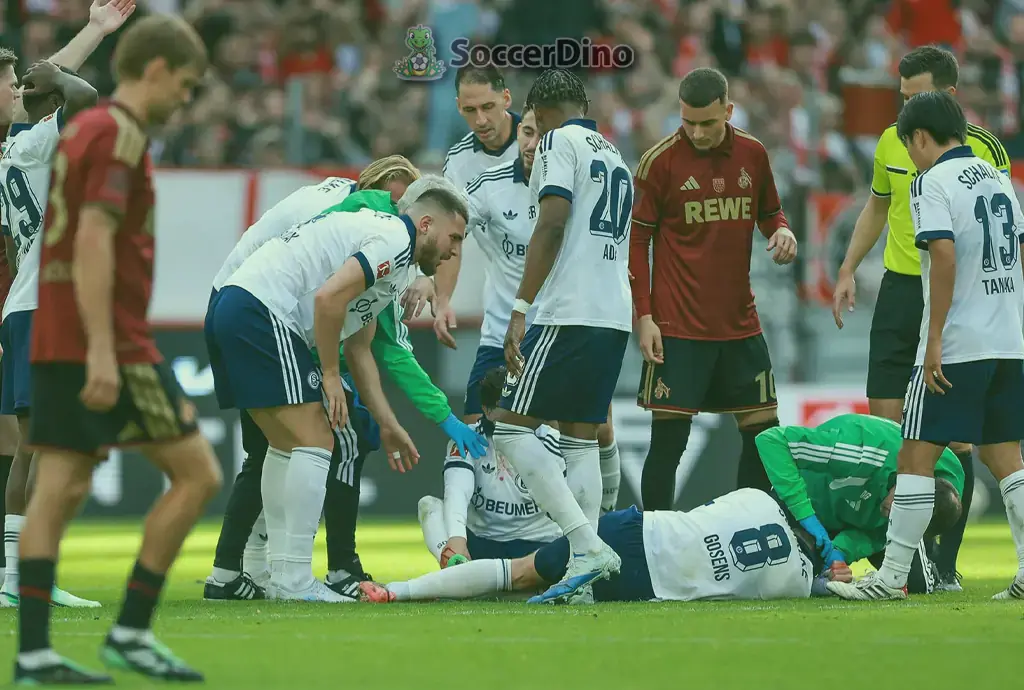
A frightening collision involving Robin Gosens and Soufiane El-Faouzi overshadowed Saturday's match between Cologne and Schalke, leaving both players requiring extensive medical treatment on the pitch before being taken to hospital. The incident, which occurred in the 37th minute, caused considerable concern among players and spectators as medical personnel from both clubs rushed to assist the injured pair.
Gosens suffered 2 cuts to his forehead, while teammate El-Faouzi sustained a broken nose after the players collided head-first while challenging for an aerial ball. The incident followed a slight push from Cologne's Said El Mala, whose involvement subsequently became a subject of discussion.
However, rather than blaming the Cologne player, Gosens publicly defended El Mala and rejected suggestions that he had deliberately caused the collision. The Schalke defender revealed that El Mala had contacted him personally to apologise and insisted that the consequences of the challenge were impossible to anticipate.
Both injured players received treatment at hospital following their substitutions, and Schalke subsequently provided an update on their conditions. Although the club confirmed the injuries sustained during the incident, it did not establish a specific timetable for either player's return.
The episode has drawn attention not only because of the alarming nature of the collision, but also because of the response from those involved. Gosens's decision to defend El Mala, despite suffering visible injuries himself, has offered a reminder of the importance of distinguishing between an unfortunate accident and an intentionally dangerous challenge.
Frightening collision brings concern to Cologne stadium
The incident occurred in the 37th minute of Saturday's encounter when Gosens and El-Faouzi were involved in an aerial challenge following contact from Cologne's Said El Mala.
As the players jumped to contest the ball, a slight push from El Mala contributed to the circumstances in which the 2 Schalke teammates collided head-first.
The impact immediately caused alarm. Both Gosens and El-Faouzi fell to the ground bleeding, prompting an urgent response from the medical teams of both clubs.
For spectators inside the stadium, the sight of 2 players requiring prolonged treatment following a collision involving their heads was deeply concerning.
Football regularly involves physical contact, particularly during aerial challenges, but incidents resulting in visible head injuries require a different level of attention.
In this case, the seriousness of the situation was apparent from the length of the treatment provided on the pitch and the subsequent decision to substitute both players.
The medical personnel attending to Gosens and El-Faouzi were required to assess their immediate condition before they could safely leave the playing surface.
Neither player was able to continue, and both were taken directly to hospital for further examination and treatment.
While the precise details of every medical assessment have not been made public, the injuries subsequently confirmed by Schalke demonstrated why immediate attention was necessary.
The incident became one of the defining moments of the encounter, shifting attention away from the football itself and towards the condition of the injured players.
Robin Gosens and Soufiane El-Faouzi taken to hospital after head clash
After receiving several minutes of treatment on the pitch, Gosens and El-Faouzi were both substituted and transported to hospital.
Schalke later confirmed that Gosens had sustained 2 cuts to his forehead, while El-Faouzi had suffered a fractured nasal bone.
Although the injuries differed, both players had been involved in the same forceful collision, making further medical assessment an important part of the response.
A broken nose can be particularly uncomfortable for professional footballers because of the physical demands of the sport and the possibility of further contact during matches and training.
The recovery process can depend on several factors, including the nature of the fracture, associated swelling and the medical assessment of whether a player can safely return to contact activities.
For Gosens, the immediate injuries involved 2 cuts to his forehead. Such wounds can produce considerable bleeding, making an incident appear especially alarming to those watching.
However, visible injuries do not necessarily provide a complete picture of the effects of a collision involving the head. Medical professionals must also consider symptoms and potential complications that may not be immediately apparent.
Schalke have not announced a definitive recovery period for either player, and there has been no confirmed information establishing when they will be available for selection again.
Instead, the club explained that decisions regarding their return would be made individually.
That approach reflects the fact that 2 players involved in the same incident can experience different injuries and require different recovery plans.
Gosens shares hospital photograph and thanks medical staff
The day after the match, Gosens offered an encouraging update by sharing a photograph from hospital alongside his teammate.
Although the defender appeared visibly affected by the collision, his message focused primarily on gratitude towards those who had helped both players during the incident and its aftermath.
"We were lucky despite the circumstances. Thank you to everyone involved who helped yesterday and made sure that we are already doing relatively well today, considering what happened. A huge thank you also to Cologne's medical team!" Gosens wrote.
The message provided welcome reassurance after the alarming scenes witnessed at the stadium.
Importantly, Gosens did not suggest that the incident had been insignificant. His reference to being fortunate acknowledged how serious the collision had appeared and how differently such situations can sometimes develop.
His appreciation for Cologne's medical department was also noteworthy.
Although the 2 clubs were competing against each other, the circumstances required an immediate and coordinated response that extended beyond the usual boundaries of sporting rivalry.
Medical teams from both sides had attended to the injured players, demonstrating the importance of cooperation when the health of participants becomes the immediate priority.
For Gosens and El-Faouzi, the treatment provided during those first minutes was followed by hospital care and subsequent assessment.
Gosens's public message also helped supporters understand that the players were recovering from the immediate effects of the incident, even though their longer-term availability remained uncertain.
Robin Gosens refuses to blame Said El Mala for the accident
Perhaps the most significant aspect of Gosens's response was his decision to defend Said El Mala, the Cologne player whose slight push preceded the collision.
The incident had inevitably raised questions about the challenge and whether the contact had contributed to the injuries suffered by the Schalke players.
However, Gosens made it clear that he did not believe El Mala should be accused of deliberately causing the accident.
"Said messaged me last night to apologise. I think it's unfair to accuse him of deliberately causing the incident. The push had consequences that no player could have anticipated. It was simply a very unfortunate situation," Gosens explained.
Those comments provided an important distinction between the physical action that contributed to the collision and the intentions of the player involved.
Football is a contact sport in which players frequently use their bodies to compete for space, maintain balance and challenge opponents for possession.
During aerial duels, relatively small movements can influence the positioning of other players. When several footballers jump for the same ball, a minor change in balance or direction can produce consequences that are difficult to predict.
That does not mean every push or challenge is acceptable under football's rules. However, determining whether an action was careless, reckless or deliberate requires consideration of its specific circumstances.
Gosens's comments addressed the question of intention directly. Having been involved in the collision himself, he rejected the idea that El Mala had consciously attempted to injure either Schalke player.
His intervention also helped prevent the discussion from focusing exclusively on blame when the immediate priority remained the recovery of the injured players.
Said El Mala apologises after unfortunate incident against Schalke
El Mala had already expressed remorse immediately after the match, acknowledging his involvement in the challenge and explaining that he had not realised the extent of the contact.
Speaking to Sky, the Cologne player said he had simply been attempting to position himself during the aerial contest.
"I'm incredibly sorry. I was just trying to use my body a little in the challenge, and at first I didn't even realise that I had pushed him that hard. I've already apologised," El Mala explained.
His comments suggested that the consequences of the incident had come as a shock to him.
Although his movement contributed to the circumstances surrounding the head clash, El Mala insisted that he had not intended to create a dangerous situation.
The Cologne player also demonstrated his concern by contacting Gosens personally after the match.
That gesture was subsequently acknowledged by the Schalke defender, who confirmed that he had received an apology and considered accusations of deliberate misconduct unfair.
The exchange between the players became an important part of the story because it showed that the individuals most directly involved were seeking to address the incident without escalating tensions.
In emotionally charged football matches, physical challenges can easily lead to disagreements between players, supporters and coaching staff.
When an incident results in serious-looking injuries, those reactions can become even more intense.
However, the available statements from Gosens and El Mala present a different picture: one player expressing regret over the unintended consequences of his challenge, and another accepting that the situation had developed in a way nobody could reasonably have wanted.
How the collision involving Gosens and El-Faouzi happened
The sequence began in the 37th minute as several players became involved in an aerial challenge.
El Mala applied a slight push while attempting to compete for position. In the resulting movement, Gosens and El-Faouzi collided with their heads as they jumped for the ball.
Both Schalke players immediately fell to the ground and required treatment.
The unfortunate nature of the incident was that the 2 injured players were teammates, rather than direct opponents challenging each other.
Although the original contact came from an opposing player, the collision itself occurred between Gosens and El-Faouzi.
This distinction helps explain why the incident developed in such an unexpected manner.
In aerial situations, players must concentrate on the flight of the ball while remaining aware of the movements of opponents and teammates around them.
The combination of upward movement, physical contact and limited reaction time can create dangerous situations even when a challenge initially appears relatively ordinary.
Once players have committed to jumping, their ability to change direction or avoid contact can become restricted.
The collision at Cologne illustrated how quickly an apparently routine contest for possession can develop into a medical emergency.
However, without additional verified information about the precise positions and movements of the players, it would be inappropriate to assign a more detailed mechanical explanation to the impact.
The established facts are that El Mala's push preceded the head clash, both Schalke players were injured and lengthy treatment was required before they could be taken to hospital.
Why head collisions demand immediate medical attention in football
The incident also brought renewed attention to the management of head injuries in professional football.
While players regularly experience physical contact during matches, collisions involving the head require particular care because some potential consequences may not be immediately visible.
Injuries such as cuts and facial fractures are often apparent soon after contact. However, medical professionals must also consider whether there are symptoms or signs of additional injury.
The presence of visible bleeding does not, by itself, establish the full severity of an incident.
Similarly, a player appearing alert after a collision does not automatically mean that every potential concern has been excluded.
That is why the immediate response from medical teams is so important.
In Cologne, both clubs' medical personnel attended to Gosens and El-Faouzi, and neither player was allowed to continue participating in the match.
The decision to substitute both footballers and arrange further assessment reflected the need to prioritise their condition rather than the competitive demands of the encounter.
The precise examinations performed at hospital have not been publicly detailed in the information available, and there is no basis for claiming that either player suffered a concussion or another unconfirmed injury.
Nevertheless, the incident illustrates why medical assessments must be guided by the players' individual symptoms, examinations and recovery rather than by the apparent urgency of returning to competition.
Schalke decline to announce return dates for injured players
Following the match, Schalke provided an official update on the injuries suffered by Gosens and El-Faouzi.
The club confirmed the 2 forehead cuts sustained by Gosens and the broken nose suffered by El-Faouzi, but stopped short of establishing when either footballer would return to action.
Instead, Schalke explained that their availability would be assessed individually.
That decision leaves uncertainty surrounding the club's immediate selection options.
For coaching staff, losing 2 players during the same incident presents an unusual challenge. Even when both injuries are caused by a single moment, the medical circumstances and recovery requirements may be entirely different.
It is therefore possible for the players to follow different rehabilitation schedules, although no specific timeline has been confirmed in this case.
Schalke will need to assess the condition of both footballers before determining whether they can return to normal training and competitive matches.
With no confirmed return dates, supporters should avoid drawing conclusions about the length of either absence.
Gosens's encouraging message from hospital provides reassurance about the players' immediate condition, but it does not replace a medical assessment of their readiness to resume competitive football.
For the club, the priority will be ensuring that both players receive the treatment and recovery time they require.
Robin Gosens determined to return and help Schalke
Despite the injuries and the frightening nature of the collision, Gosens made clear that both he and El-Faouzi were already thinking about returning to football.
"Soufi and I will recover as quickly as possible so we can get back to helping the team," he said.
The comment reflected the determination commonly associated with professional footballers, who are accustomed to balancing the disappointment of injuries with the desire to return to competition.
However, the circumstances surrounding this particular incident make it important that recovery is not rushed.
Both players have experienced injuries affecting the head or face, and their return will need to depend on the assessments made by the relevant medical professionals.
Gosens's words should therefore be understood as an expression of motivation rather than an indication that either player is ready to resume training immediately.
The defender's response also highlighted the bond between the 2 teammates.
Having been involved in the same collision and received treatment at the same hospital, Gosens and El-Faouzi now share an experience that neither would have wanted.
Their recovery will take place under different medical circumstances, but the public message suggested that both remain focused on returning to support Schalke.
For supporters, that determination provides encouragement after a distressing matchday incident.
Medical teams from Cologne and Schalke praised for their response
Gosens reserved particular praise for the medical personnel who responded to the collision, including the staff representing Cologne.
His message was significant because football rivalries often dominate attention during matches, with players and supporters focused primarily on securing a positive result.
However, serious injuries create circumstances in which those competitive divisions become secondary.
In Cologne, the medical teams from both clubs provided assistance to the injured Schalke players, demonstrating the shared responsibility that exists when a participant requires urgent care.
Medical staff must make decisions based on the condition of the patient, regardless of which team the individual represents.
Such situations can involve substantial pressure because assessments must begin quickly, often while players, officials and thousands of spectators are watching.
The response at Cologne ensured that Gosens and El-Faouzi received attention on the pitch before being transferred for further treatment.
Gosens's subsequent expression of gratitude publicly acknowledged that assistance.
Although the injuries themselves were unfortunate, the cooperation between the medical departments provided an important positive element in the aftermath.
The incident also demonstrated that player welfare is a responsibility shared across the sport, rather than an issue confined to individual clubs.
Gosens's defence of El Mala sends important message about football injuries
One of the most notable aspects of the aftermath was the restraint shown by Gosens when discussing the challenge that preceded the collision.
Having suffered 2 cuts to his forehead and required hospital treatment, the Schalke defender could understandably have been frustrated by the circumstances.
Instead, he chose to acknowledge El Mala's apology and defend the Cologne player against accusations of deliberate wrongdoing.
That distinction is important because the consequences of a challenge do not always provide a complete explanation of the intention behind it.
A relatively minor action can sometimes contribute to a serious accident, while other challenges involving greater force may not produce any injury at all.
Assessing individual incidents therefore requires consideration of both the action itself and the circumstances in which it occurred.
Gosens did not deny that El Mala's push had played a role. Instead, he argued that the resulting collision was not something the Cologne player could have anticipated.
His comments also demonstrated an awareness of the emotional consequences such incidents can have for those who unintentionally contribute to an injury.
El Mala had already expressed regret in his post-match interview, explaining that he had not realised how strongly he had pushed during the challenge.
By confirming the subsequent private apology and rejecting accusations of intent, Gosens helped prevent the situation from developing into a personal dispute.
The exchange offered an example of how players can acknowledge an unfortunate incident while maintaining mutual respect.
Schalke face uncertainty over Gosens and El-Faouzi availability
From a sporting perspective, the injuries create an additional concern for Schalke as the club prepares for its next fixtures.
Gosens and El-Faouzi were both forced to leave the match in the 37th minute, meaning the team lost 2 players during the same passage of play.
Such situations can disrupt a team's structure because coaches must respond immediately to unexpected substitutions.
Depending on the positions and responsibilities of the injured players, those changes may also influence how a team approaches the remainder of a match.
However, the final result and the specific tactical adjustments made following the incident were not included in the available match account.
The more immediate issue is whether either player will require a prolonged absence.
Schalke have provided confirmed diagnoses but have not specified recovery periods, leaving the club's future selection options uncertain.
The situation will become clearer once the players have undergone any necessary follow-up assessments and their recovery has progressed sufficiently for the medical staff to evaluate their readiness.
For Gosens, treatment will need to address the forehead injuries and any other concerns identified during medical assessment.
For El-Faouzi, the fractured nasal bone will require its own recovery considerations.
There is no confirmed basis for predicting which player will return first.
Schalke's statement that each case will be considered individually is therefore the most reliable indication of how their respective recoveries will be managed.
An unfortunate accident that overshadowed the football in Cologne
The collision between Gosens and El-Faouzi will remain the most concerning aspect of Saturday's encounter in Cologne.
What began as an aerial challenge developed into an incident requiring prolonged medical intervention, with 2 Schalke players suffering injuries and leaving the stadium for hospital treatment.
The subsequent updates have provided some reassurance. Gosens was able to share a message thanking everyone who assisted, and the club confirmed the specific injuries suffered by both players.
However, the uncertainty surrounding their return means that the situation remains ongoing from a sporting perspective.
For El Mala, the incident has also been difficult. His post-match comments conveyed regret over the consequences of a challenge that he said was not intended to cause harm.
The fact that he contacted Gosens personally demonstrated his willingness to acknowledge what had happened and express concern for those injured.
Gosens's response helped shift attention away from accusations and towards recovery.
His message did not attempt to minimise the collision. Instead, it recognised that a physical action in a football match had produced consequences nobody intended.
That perspective was especially important given the seriousness of the scenes witnessed by spectators.
Football's competitive intensity can make incidents of this nature emotionally charged, but the exchange between the players illustrated that concern, responsibility and respect can remain central to the discussion.
What happens next for Robin Gosens and Soufiane El-Faouzi?
The immediate priority for both players is their recovery following the injuries sustained in the 37th-minute collision.
Schalke have confirmed that Gosens suffered 2 forehead cuts and El-Faouzi sustained a broken nose, but no definitive absence period has been announced.
The club has indicated that decisions regarding each player's return will be made individually, meaning further medical assessment and recovery progress will determine when they can resume competitive action.
Gosens's message from hospital offered an encouraging update about their general condition and made clear that both players are determined to return as quickly as possible.
However, the absence of confirmed return dates means there is currently no reliable basis for predicting whether either footballer will be available for Schalke's next match.
For now, supporters will be hoping that the recovery process proceeds without complications and that both players can return to the pitch when medically cleared.
The club's medical staff will play an important role in those decisions, just as the personnel from both Schalke and Cologne played an essential part in responding to the original incident.
Gosens and El-Faouzi focus on recovery after frightening Cologne collision
Saturday's match in Cologne produced a disturbing moment when Robin Gosens and Soufiane El-Faouzi collided head-first following a slight push from Said El Mala during an aerial challenge.
Both Schalke players fell to the ground bleeding and required lengthy treatment from the medical teams of both clubs before being substituted and taken directly to hospital.
Gosens suffered 2 cuts to his forehead, while El-Faouzi sustained a broken nose. Schalke subsequently confirmed the diagnoses but declined to announce specific return dates, explaining that each case would be assessed individually.
The following day, Gosens shared an encouraging photograph and message from hospital, expressing gratitude towards everyone who had helped and particularly praising Cologne's medical personnel.
His response also addressed the controversy surrounding El Mala's involvement.
Rather than accusing the Cologne player of deliberately causing the collision, Gosens defended him and confirmed that he had already received a personal apology.
El Mala had also expressed remorse in an interview with Sky, explaining that he had simply been attempting to position himself during the challenge and had not realised the consequences of the contact.
The exchange between the players has provided a constructive conclusion to the immediate discussion surrounding the incident, even though the medical situation remains unresolved.
For Schalke, the uncertainty over Gosens and El-Faouzi is an unwelcome concern. Losing 2 players in the same incident presents challenges that extend beyond the match in which the injuries occurred.
However, the most important outcome will be ensuring that both players make a full recovery and return when they are ready.
Gosens has already made his intention clear: he and El-Faouzi want to recover and help their team again.
Until then, the collision in Cologne stands as a reminder of football's physical unpredictability, the importance of an immediate medical response and the value of mutual respect between players even when an unfortunate challenge produces serious consequences.