Ange Postecoglou defended Cristiano Ronaldo after Al-Nassr suffered a 4-0 defeat to Al Ain, insisting criticism should be directed at him instead.
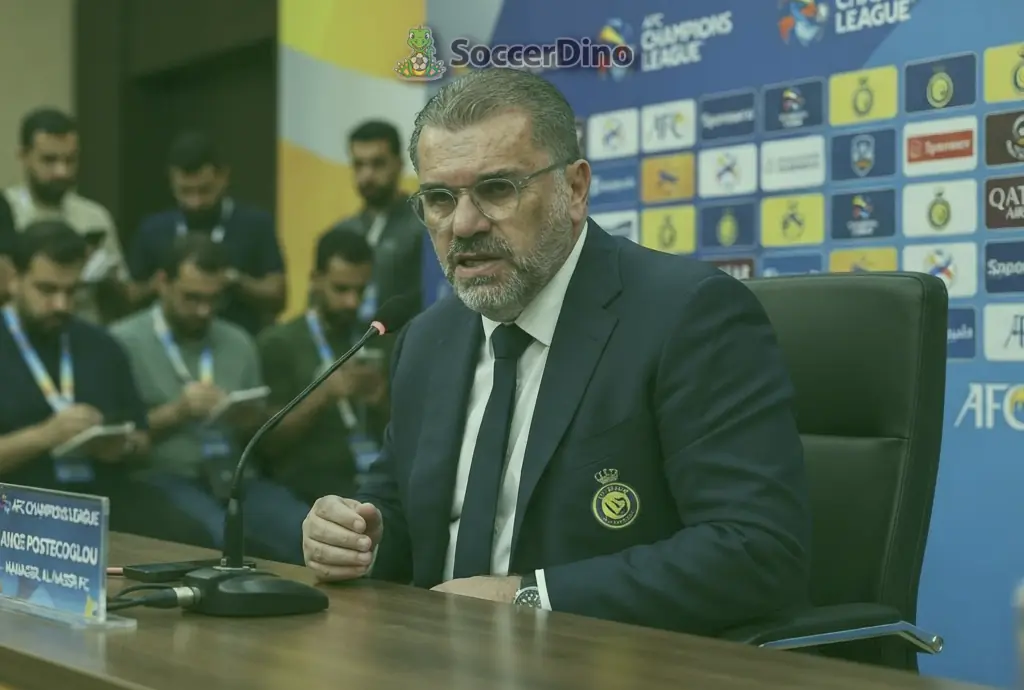
Postecoglou defends Ronaldo after heavy Al-Nassr defeat
Al-Nassr endured a difficult start to their AFC Champions League campaign as they were beaten 4-0 away by Al Ain, a result that immediately placed pressure on Ange Postecoglou and his players. Cristiano Ronaldo, now 41, was unable to change the course of the match despite arriving with three goals for his club since returning from the World Cup and his subsequent holiday. The heavy defeat quickly shifted attention towards the Portuguese forward, with questions raised over his recent performances, but Postecoglou strongly rejected the suggestion that Ronaldo had not been contributing enough. Instead, the Australian coach defended his captain and insisted that any criticism following the result should be directed at him rather than at a player he described as an elite professional who continues to give everything despite the demands of maintaining his career at such an advanced age.
The exchange came after a journalist suggested that Ronaldo had “not shown much” in Al-Nassr last three matches. Postecoglou immediately challenged that assessment and pointed to the forward recent scoring record as evidence that the criticism was unfair. “I think you must be watching different matches from me,” he said. “Cristiano has already scored three goals since returning from the World Cup and his holiday. He has not had much time to prepare for his return, but he gives everything. Cristiano is an absolute top player with enormous character. If you need to criticise someone, criticise me.” The response made it clear that Postecoglou had no intention of allowing the 4-0 defeat to become a debate centred entirely on Ronaldo, particularly when he felt responsibility for the result should rest primarily with the coach and the team as a whole.
Postecoglou rejects criticism of Ronaldo
Postecoglou went even further when discussing the tone of the criticism and the standards he believes should be applied when assessing Ronaldo. The former Australia head coach, who has also managed Tottenham Hotspur and Nottingham Forest, argued that the Portuguese forward career and continued commitment deserve a greater degree of respect. “You should not say that about someone who is still a role model for so many people,” he said. “Be careful when you talk like that about people who have made sacrifices throughout their entire careers in order to keep playing.” His comments reflected both admiration for Ronaldo longevity and frustration at the way individual criticism can intensify after a poor team performance, particularly when the result itself was as damaging as the defeat in Al Ain.
For Postecoglou, the issue appeared to be less about denying that Ronaldo can have difficult matches and more about placing those performances in context. The forward had returned to club football after the World Cup and had already scored three times, despite what his coach described as limited preparation time. That is why Postecoglou reacted so strongly to the idea that Ronaldo had contributed little. In his view, the 41-year-old remains committed, continues to work for the team and still carries the mentality of a player accustomed to competing at the highest level. By telling reporters to criticise him instead, the coach attempted to shift the conversation away from individual blame and towards his own responsibility for a team that has now won only one of its last four competitive matches.
Heavy defeat increases pressure on Al-Nassr
The broader problem for Al-Nassr is that the defeat cannot be separated from their recent results. Postecoglou side have now won only one of their last four official matches, and beginning the AFC Champions League with a 4-0 loss inevitably increases scrutiny. The scale of the defeat matters because it was not simply a narrow away setback in the opening game of the competition. Al-Nassr were comprehensively beaten by an Al Ain side that took control of the occasion and prevented Ronaldo and his teammates from finding a route back into the match. For a club with major ambitions in continental competition, that represents a significant warning and leaves Postecoglou needing a response in the coming fixtures.
The Australian coach comments therefore carried an additional message to the rest of his squad. By protecting Ronaldo publicly, he was also making clear that the defeat should not be reduced to the performance of one player. A 4-0 loss reflects collective problems, and Postecoglou appears determined to accept responsibility rather than allow the attention to fall solely on the most famous member of the team. Ronaldo inevitably attracts greater scrutiny because of his status, but the coach insistence that criticism should be directed at him suggests he believes the solution must come through the team rather than through a debate over whether the Portuguese forward remains capable of contributing.
Ronaldo involved in physical confrontation
Ronaldo evening also included a heated moment involving Al Ain midfielder Matías Palacios. During the match, the Portuguese and Argentine players became tangled in a physical confrontation just outside the penalty area, with the exchange briefly resembling a wrestling contest as both attempted to gain position. Despite the intensity of the incident, neither player was shown a card and play continued without disciplinary consequences. The confrontation added another layer to a frustrating evening for Ronaldo, who was already seeing his side struggle badly on the scoreboard and was unable to produce the decisive attacking contribution Al-Nassr needed.
The incident was not the first time Ronaldo and Palacios had clashed. The pair had also been involved in a confrontation two years earlier during a previous meeting between Al-Nassr and Al Ain, meaning their latest encounter immediately recalled that earlier tension. Although the latest exchange did not lead to any punishment, it underlined the physical and emotional intensity of the match. Ronaldo is rarely a peripheral figure in games of this magnitude, and even on a night when he could not influence the scoreline, he remained at the centre of one of the most talked-about moments.
Ronaldo still central to Postecoglou plans
There was no indication in Postecoglou remarks that Ronaldo position within the team is under threat. On the contrary, the coach defence of the forward suggested he continues to view him as an important figure whose experience, character and goals remain valuable to Al-Nassr. The fact that Ronaldo has already scored three times since returning from the World Cup was repeatedly emphasised, and Postecoglou clearly believes those numbers should form part of any fair assessment of his current level. At 41, Ronaldo remains under a degree of scrutiny that few players of his age would face, largely because his previous standards have been so extraordinary and because expectations around him remain unusually high.
That reality means every match in which Ronaldo does not score or decisively influence the outcome is likely to generate questions, particularly when Al-Nassr lose heavily. Postecoglou appears determined to resist that cycle by judging the player over a broader period rather than on isolated performances. His message was straightforward: Ronaldo has returned, scored goals, worked for the team and continues to demonstrate the mentality expected from an elite professional. A difficult night against Al Ain does not, in the coach view, justify portraying him as the central problem.
Al-Nassr need immediate response
The focus now turns to how Al-Nassr respond. One victory from four competitive matches is not the run Postecoglou would have wanted, and a 4-0 defeat in the opening AFC Champions League fixture makes the next games even more important. The coach has already accepted public responsibility and defended his most experienced player, but the strongest answer will need to come on the pitch. Al-Nassr must rediscover the competitiveness and consistency required to avoid allowing one difficult result to develop into a more serious period of instability.
For Ronaldo, the challenge is familiar. The scrutiny will continue because of who he is, his age and the standards he has established throughout his career. Postecoglou, however, has made his position unmistakably clear. He does not believe the Portuguese forward deserves to be singled out after the loss in Al Ain, and he remains convinced that Ronaldo is still giving everything to the team. The Australian coach wants the responsibility for the recent results to remain with him and with the collective, not with one individual. After a painful 4-0 defeat and only one win from the last four competitive matches, Al-Nassr now need the kind of reaction Postecoglou was defending Ronaldo for still trying to provide.