Barcelona’s coach previewed the Spanish Super Cup final on Saturday, scheduled for tomorrow in Saudi Arabia. Mbappé has recovered from injury and might be available, but Hansi Flick played it down.
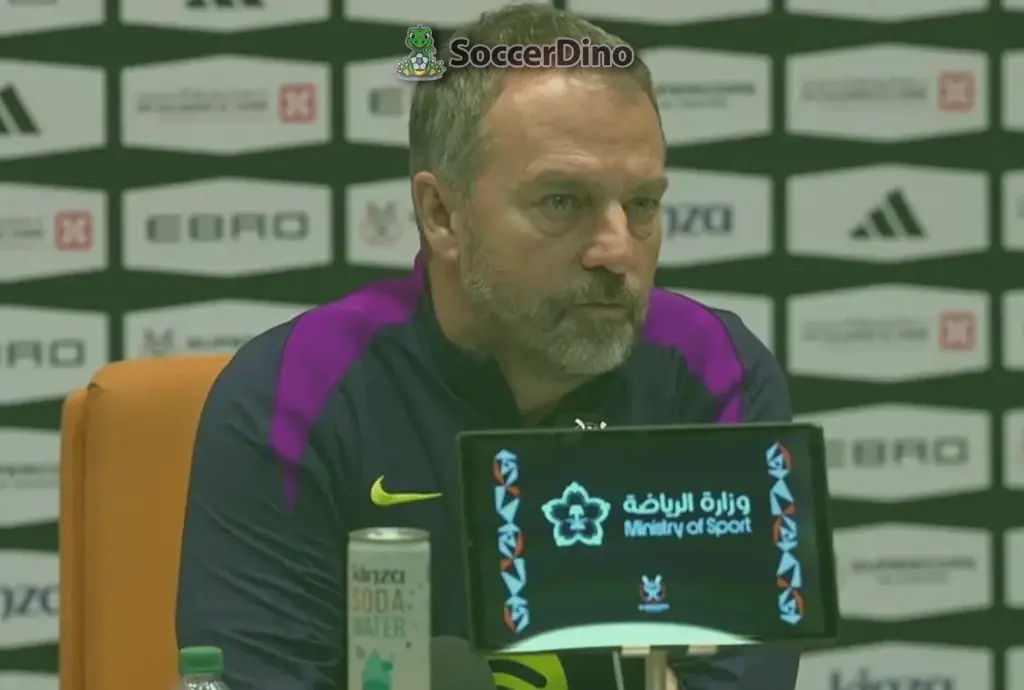
With the Spanish Super Cup final set to take place in Saudi Arabia, Barcelona coach Hansi Flick used his pre-match media duties to steer the conversation away from individual storylines and back toward the collective challenge of facing Real Madrid.
Even with speculation swirling around Kylian Mbappé’s fitness and the possibility of his involvement, Flick made it clear that Barcelona’s preparation is not built around stopping a single star, but around competing with and overcoming a complete team that is used to deciding finals.
Flick’s central message was straightforward: Barcelona are playing Real Madrid, not Mbappé. He acknowledged Mbappé’s quality, but treated the discussion of his return from injury as a secondary detail rather than a defining factor. From Flick’s perspective, it would be a mistake to reduce a Clásico final to a duel against one forward, especially against an opponent whose threat comes in multiple forms and whose match-winning capacity extends far beyond any individual name on the team sheet. The implication was also tactical. Barcelona will adjust certain details, but the starting point is their own game model, their own structure, and the behaviour they want to see with and without the ball.
The coach also leaned on precedent to take the heat out of the Mbappé narrative. He referenced the number of Clásicos played against Mbappé and pointed out that Barcelona’s record in those matches is not one of consistent struggle. The underlying point was psychological as much as it was analytical: Barcelona should not enter a final feeling intimidated by a headline, even if that headline involves one of the most decisive forwards in world football. Flick’s approach is to keep the group mentally stable and focused on controllable details, rather than allowing external noise to set the emotional temperature of the dressing room.
Beyond the Mbappé angle, Flick repeatedly returned to what he considers the defining requirement for winning a final: unity and collective performance. He highlighted the standard he wants to see, pointing to a previous match against Athletic Bilbao as a benchmark for the attitude and cohesion he expects. In a game as emotionally charged as El Clásico, this is not a throwaway line. Finals often swing on moments of disconnection, a late track-back that does not happen, a second ball that is not contested, a defensive line that is not coordinated for just 2 seconds. Flick’s insistence on playing united is a direct response to that reality. It is also a reminder that the tactical plan will only work if the team executes it together, across all phases.
Flick also rejected the idea of favourites. That is consistent with how coaches often try to protect their squads from unnecessary pressure, but in this case it is also a recognition of how unpredictable finals can be, especially between two teams that know each other so well. In El Clásico, context matters, but it rarely guarantees outcomes. A final can be decided by an early goal that reshapes the entire game state, a set-piece detail, a single defensive error, or a red card. By refusing the favourites discussion, Flick is framing the match as a 1-off contest that demands maximum focus, rather than a referendum on broader narratives.
From Barcelona’s standpoint, lifting the Super Cup would carry value that goes beyond adding a trophy to the cabinet. Flick described it as just 1 game, and he emphasised that the team will return to domestic and European competition regardless of the outcome, but he also admitted the obvious: winning would provide confidence. For a coach implementing ideas and building consistency, early silverware can accelerate belief inside the squad, increase buy-in to the daily work, and create positive momentum that carries into the next difficult run of fixtures. It can also shift the tone around the club, easing external pressure and giving players a tangible reward for progress.
That is why Flick’s comments about concentration and satisfaction with what he sees in the players matter. He presented a group that is focused and receptive, a squad that understands the size of the occasion but is not paralysed by it. In practical terms, this suggests Barcelona’s week of preparation has been built around clarity rather than hype: clear roles, clear principles, and a clear emotional posture. Coaches will often talk about wanting calm intensity in finals, meaning aggression and courage with the ball, but also discipline and patience when the game becomes chaotic. Flick’s language points in that direction.
At the same time, Flick did not underestimate the opponent. He called Real Madrid a fantastic side, one of the best, and praised the quality of their players. This was not merely diplomatic. It aligns with the earlier point about focusing on Real Madrid as a complete entity. In a final, it is rarely enough to neutralise 1 threat. The opponent can hurt you through combinations, transitions, set pieces, second-phase attacks, and individual improvisation from multiple zones. Flick’s respect for Madrid’s overall quality is essentially an acknowledgment that Barcelona must be excellent in several dimensions at once: defensive organisation, transitional control, decision-making under pressure, and ruthlessness in the key moments near goal.
Importantly, Flick’s praise came with a clear internal priority. He stressed that his attention remains on Barcelona, on what his team needs to do to win the title. He also reinforced a coaching principle that becomes especially relevant in high-stakes matches: the collective matters more than individual names or positions. In other words, it is less important who starts on paper and more important how the team functions as a unit, how distances are managed, how pressing triggers are followed, and how responsibilities are shared when the match inevitably swings from control to chaos and back again.
All of these themes point to the same strategic posture ahead of the final. Barcelona are preparing to compete with personality, but not with panic. They are acknowledging Real Madrid’s strengths without turning those strengths into fear. They are treating Mbappé’s possible involvement as one variable among many, not as the centre of the story. And they are framing the match as a test of togetherness, execution and mental stability, the ingredients that typically decide finals when margins are tight.
When kickoff arrives, Flick will not be judged on how well he spoke about Mbappé, but on whether Barcelona look like the team he described: united, concentrated, and brave enough to play their football against elite opposition. If they achieve that, they give themselves a real chance to lift the trophy. If they do not, then the narrative will not be about 1 player returning from injury, but about which team delivered the more complete performance when it mattered most.