Bayern Munich came from behind to beat Cologne 3-1 away in the 17th round, matching their club record of 47 points at the halfway stage, while Dortmund, Leipzig and Hoffenheim also secured key wins and winter weather caused further postponements.
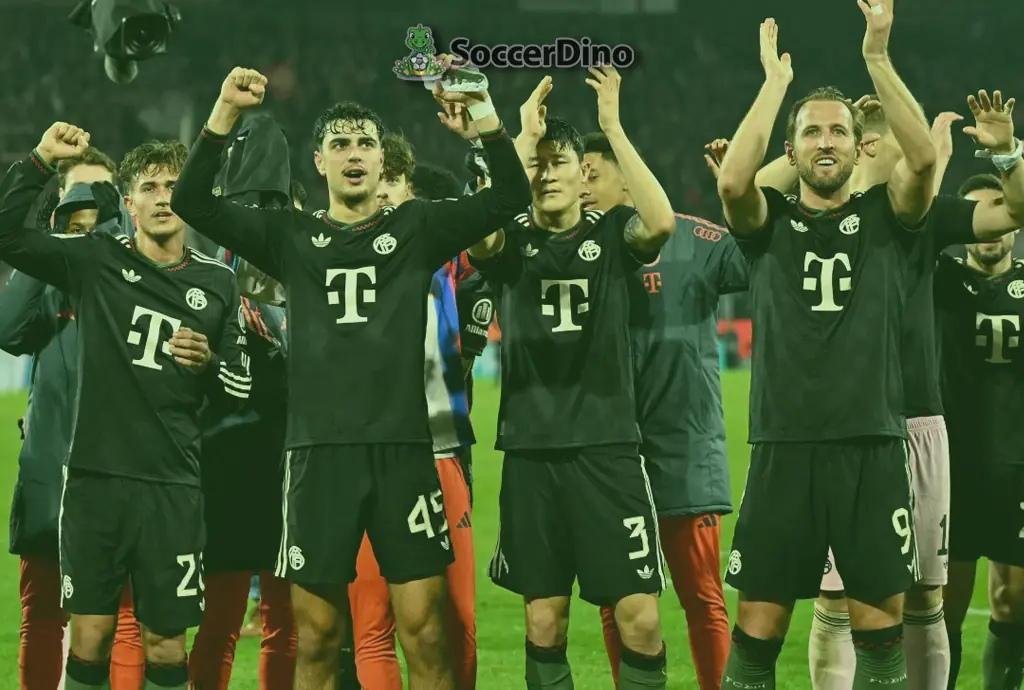
Bayern Munich’s relentless first half of the Bundesliga season reached another historic milestone on Wednesday night, as the reigning champions came from behind to beat Cologne 3–1 away and in doing so matched the best first-round points tally in the club’s league history.
The victory, sealed with a decisive second-half push, leaves Bayern with 47 points from 17 matches, the same record-setting return they achieved in the 2013/14 campaign, and reinforces the sense that Vincent Kompany’s side are combining efficiency with an attacking output that is currently unmatched in the division.
The match itself followed a script that has become increasingly familiar for Bayern this season: a period of frustration and uneven rhythm, followed by a sharp acceleration in key moments that tilts the game decisively in their favour. Cologne, fighting for points and eager to exploit any sign of complacency, managed to disrupt Bayern’s tempo for much of the first half. The home side pressed with energy and looked more comfortable than expected against a Bayern team that, while dominating possession, did not immediately turn control into clear chances.
That resistance was rewarded in the 41st minute when Linton Maina put Cologne ahead, sparking hopes of a major upset. For a few minutes, Bayern looked rattled, and the game threatened to become the kind of difficult away night in which small margins decide everything. However, the league leaders responded at the most psychologically damaging moment for the hosts: in stoppage time before the break. Serge Gnabry’s equaliser in the 45+5 minute not only restored parity, it shifted the emotional balance of the match. Cologne’s advantage disappeared just as they were preparing to go into half-time with momentum, while Bayern regained the sense that the game was there to be taken.
After the interval, the contest gradually turned into a test of depth, composure, and the ability to manage pressure. Cologne’s early intensity inevitably dropped, and Bayern’s structure began to assert itself more clearly. The decisive moment came in the 71st minute, when Kim Min-jae scored to complete the turnaround. It was a goal that encapsulated Bayern’s ability to find solutions beyond their forward line, with the South Korean defender stepping up at a critical point to put the visitors in front. From there, Cologne were forced to chase, opening spaces that Bayern are particularly ruthless at exploiting.
The final confirmation arrived in the 84th minute, when substitute Lennart Karl scored to make it 3–1 and remove any remaining doubt. The late goal reflected another theme of Bayern’s season: the capacity to influence matches from the bench and to maintain intensity deep into the second half. Even in matches where the performance is not perfect, the depth of the squad and the clarity of their attacking patterns allow them to finish games strongly.
Beyond the immediate result, the numbers behind Bayern’s first half underline why the win in Cologne was framed as a record-equalling moment. Bayern have now recorded 15 wins and 2 draws, remaining unbeaten and producing a points total that very few teams can sustain over a full season. The benchmark comparison is their own 2013/14 campaign, when Bayern hit the same points mark under Pep Guardiola. That season was remembered for control and consistency, and it has long stood as a reference point for domestic dominance. Matching it in the current context is significant, especially given the heightened competition and the scrutiny that follows any Bayern side expected to win every week.
What makes this first half stand out even more is the attacking volume. In 2013/14, Bayern scored 44 goals across 17 matches. Kompany’s current team has scored 66 over the same span, a staggering average of 3.88 goals per game. That statistic hints at a different flavour of dominance: not merely controlling matches, but overwhelming opponents with sustained chance creation and the ability to convert pressure into goals with remarkable regularity. It also raises the bar for what success looks like for this Bayern side, because historic attacking output often comes with expectations of equally historic trophy returns.
There was also a brief Portuguese note late in the game, with Raphael Guerreiro introduced in the 88th minute. His late appearance suggests Bayern were managing minutes after the match was essentially decided. In contrast, compatriot David Daiber did not feature, highlighting the competitive depth within the squad and the reality that even established internationals will rotate in and out depending on game context and tactical needs.
At the top of the table, Bayern’s advantage remains clear. Having won 12 of the last 13 Bundesliga titles, they have again positioned themselves as the team everyone is chasing. Borussia Dortmund sit second on 36 points after a 3–0 home victory over Werder Bremen on Tuesday, but the gap reflects how little room there is for rivals when Bayern maintain this level of consistency. For Dortmund, the challenge is not only winning regularly, but doing so while hoping Bayern’s pace eventually drops, something that has not happened so far.
Behind Dortmund, Leipzig’s 2–0 home win over Freiburg provided an important course correction after two consecutive defeats. Goals from Willi Orbán in the 53rd minute and Rômulo in the 56th sealed the result, and Leipzig’s position in third, with a game in hand, keeps them firmly in the Champions League conversation. Their ability to stabilise quickly after setbacks will matter, especially in a season where the race for the top four looks congested and where momentum swings can rapidly change the shape of the table.
Leipzig are level on 32 points with Stuttgart, who are fourth after Monday’s 3–2 win at home to Eintracht Frankfurt. That result, which opened the round, continued Stuttgart’s strong campaign and reinforced the sense that they are not simply a short-term surprise, but a team capable of sustaining a top-four pace over a meaningful stretch. The fact that Leipzig and Stuttgart are locked together on points also increases the pressure on both clubs, because every dropped point can immediately be punished.
Just below them, Hoffenheim moved provisionally into fifth place with 30 points after an emphatic 5–1 home win over Borussia Mönchengladbach. The standout was Andrej Kramarić, who scored a first-half hat-trick, beginning with a penalty. A margin like that does more than add three points: it can reshape goal difference, restore confidence, and send a message to direct competitors. For Hoffenheim, the caveat is that they still have a postponed fixture in the background, meaning the standings may shift again once the calendar normalises.
At the other end of the table, the relegation picture remains tense and crowded. St. Pauli, pushed into the bottom zone after Mainz beat Heidenheim 2–1 the day before, suffered a 2–1 defeat away at Wolfsburg. The match was decided late by Dzenan Pejcinović, a moment that underlined how fine the margins are for teams fighting to survive. Results like that can be especially damaging because they combine the psychological blow of losing late with the broader reality that points are scarce.
The bottom three are all on 12 points, only two behind the safety line, so the situation is far from settled. However, goal difference is currently a major factor: St. Pauli, who also have a game in hand, and Heidenheim occupy the two automatic relegation spots, while Mainz sit 16th in the promotion-relegation play-off position. In practical terms, this means that a single positive result can change the hierarchy, but also that teams cannot rely solely on collecting points; they may need to manage the margins of defeats and seek more decisive wins where possible.
The schedule has also been influenced by winter conditions, adding another layer of unpredictability. The 17th round continues on Thursday with Union Berlin visiting Augsburg, but the round will only be completed once Hamburg host Bayer Leverkusen, last season’s runners-up, in a match postponed due to adverse weather. A new date has not yet been confirmed. Weather-related disruption has been a theme: in the 16th round, the first after the winter break, St. Pauli vs Leipzig and Werder Bremen vs Hoffenheim were also rescheduled due to safety concerns linked to snow and ice. Postponements can create uneven rhythms, especially for teams trying to build form, and they can complicate the standings when some clubs have games in hand while others have already completed the round.
Taken together, the latest Bayern win is not just another three points, but part of a broader narrative of dominance: record-level consistency, extraordinary goal production, and the ability to solve difficult away matches even when the performance begins imperfectly. For the chasing pack, the message is familiar and uncomfortable: if Bayern are going to be caught, it will likely require near-flawless runs from everyone else, and a rare wobble from a side that so far has given very little away.