Sportingly, nothing is going right for Eintracht Frankfurt, but the club has more fires to put out. It has reportedly sacked the team doctor for a remarkable reason.
Sportingly, nothing is going right for Eintracht Frankfurt, and the club has more fires to put out. It has reportedly sacked the team doctor for a remarkable and controversial reason, at a time when the team is preparing for a high profile Champions League match away to FC Barcelona on 9 December 2025 at 21:00.
What should be a week focused entirely on tactics, recovery and mental preparation for a huge European night has turned into yet another chapter in a growing internal crisis.
German media report that Fabian Plachel is no longer employed by Eintracht with immediate effect because he provided medical treatment to a player from the opposing team. The case goes back to the beginning of November, when Eintracht faced FC Heidenheim. During that period, a Heidenheim player needed specialised medical attention, and Plachel is said to have stepped in and helped, drawing on his expertise as team doctor of Eintracht Frankfurt.
The Heidenheim player in question, believed to be forward Mathias Honsak, was spotted around the time of the match at Eintracht’s team hotel. That detail, which might seem harmless from the outside, has reportedly caused irritation among several members of the Frankfurt squad. For some players, it created the feeling that the boundaries between the club and its opponents had been blurred at an already tense moment in the season. In the dressing room, the presence of an opposition player in such a private space around a competitive fixture is said to have raised eyebrows and prompted questions.
The discontent was not restricted to the players. In the boardroom, there was also annoyance and surprise, as the medical treatment for the Heidenheim player was allegedly provided without any formal communication to or approval from the club. According to German reports, the leadership was informed of the episode only afterwards. From their perspective, a key staff member had taken a decision on his own initiative that not only affected internal protocols but also created an awkward optic at a time when every action around the club is under scrutiny.
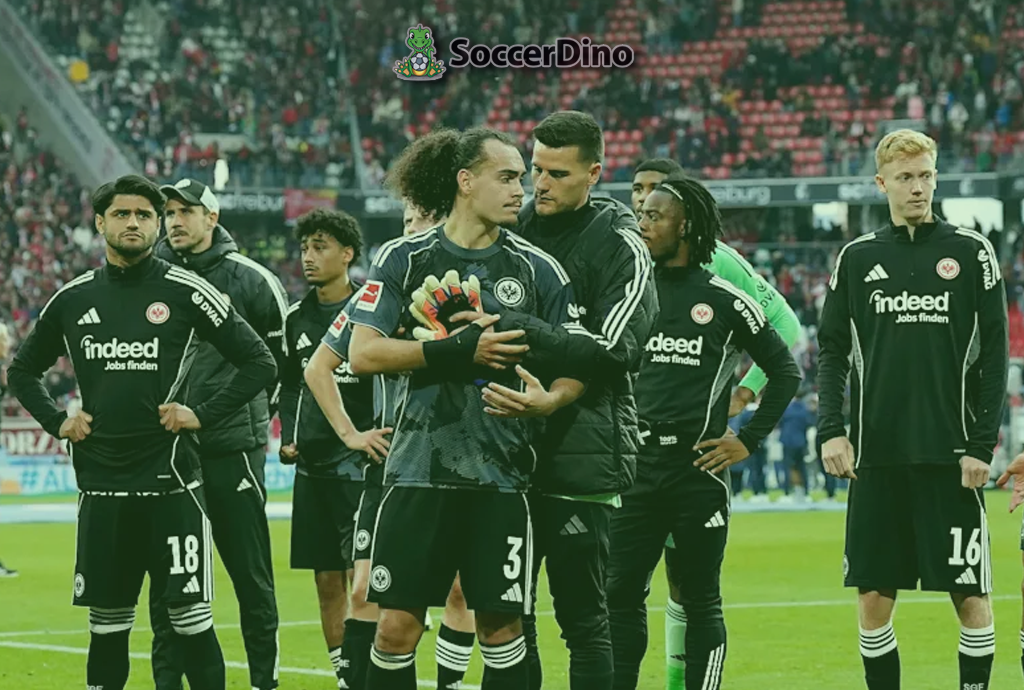
Plachel has now been pushed aside by the management. His dismissal comes in a phase of the season when Eintracht are struggling to pick up points and the pressure around everyone connected to the club is rising. Last season, Frankfurt celebrated qualification for the Champions League and spoke confidently about building a project that could compete both in Germany and in Europe. Now the reality is more complicated. The team currently sits in seventh place in the Bundesliga, outside the comfort zone of the top four and looking nervously over its shoulder at rivals who are closing the gap.
The heavy 6 0 defeat to Leipzig last weekend has only made things worse. It was not just the result, but the manner of the collapse that alarmed fans and directors. Eintracht were second best in intensity, organisation and mentality, and the performance left the impression of a team short of confidence and clear ideas. In that context, the decision to remove the team doctor, especially for a non sporting reason, adds another layer of instability to a club that can hardly afford further distractions.
From a sporting and psychological point of view, the timing of this dismissal could hardly be worse. Medical staff are deeply embedded in the daily life of a squad. They follow injuries, monitor recovery, plan workloads and enjoy close personal relationships with players who trust them with their bodies and sometimes with their personal concerns. Losing a long serving doctor just days before a crucial Champions League match disrupts routines and creates uncertainty. Even if a replacement or interim solution is quickly installed, the dynamic around the treatment room and training ground inevitably changes.
On Tuesday evening, Eintracht play away at Barcelona in the Champions League. The Germans are not doing much better in that competition and have collected only four points from five matches. Their campaign so far has been marked by inconsistent performances. At times they have shown flashes of the quality that brought them into the competition, with quick transitions and dangerous attacking phases. At other moments, they have looked fragile at the back and unable to manage games against opponents who control possession.
Facing Barcelona at the Olympic Stadium or Camp Nou, depending on the venue chosen for the match, is a daunting task even for confident and stable teams. For an Eintracht side battling on several fronts, it becomes an examination of character as much as of tactical preparation. The Spanish giants will look to dominate the ball, stretch Frankfurt’s defensive lines and exploit any hesitation or lack of coordination at the back. For Eintracht, concentration and collective effort will be essential if they are to avoid another heavy defeat that could severely damage their chances of progressing.
Inside the club, the Plachel case is also being interpreted as a symbol of a broader debate. Some voices argue that providing medical help to an opponent is simply an act of professional ethics and human decency, especially if the player was in need of specialised care. Others insist that, in the high pressure context of elite football, protocols and loyalty to the club must come first, and that such decisions should never be taken without informing the hierarchy. The fact that this discussion has become public reflects the tense atmosphere around Eintracht at the moment.
For the supporters, the episode is another confusing storyline in a season that was supposed to confirm the club’s growth. Many fans are more concerned with what they see on the pitch than with disputes over internal procedures, and their main demand is for the team to react in Barcelona. A courageous performance, even if it does not bring a win, could at least restore some pride and show that the players are ready to fight for the badge despite the noise surrounding them.
For the players and coaching staff, the coming days will be about shutting out that noise as much as possible. Training sessions will need to be focused on defensive organisation, pressing triggers and attacking patterns that can hurt Barcelona on the counter. At the same time, the new medical structure must quickly gain the trust of the squad so that there are no doubts about injury management or readiness for the match.
Whatever happens in Barcelona, the story of Fabian Plachel’s dismissal will remain a remarkable chapter in Eintracht’s season. It illustrates how, in modern football, crises rarely come alone. Poor sporting form, heavy defeats, internal disagreements and public controversies often arrive together and feed each other. For Eintracht Frankfurt, the challenge now is to prevent this off field issue from further derailing a campaign that is already on the edge, and to show in one of the toughest stadiums in Europe that they still have the strength to compete at the highest level.